
Proud to be part of LJMU,
in partnership with the Dill Faulkes Educational Trust


Ibn al-Haytham

Occupation

Astronomer, Mathematician, Physicist

Year Born

around 965

Research Areas

Optics, Vision, Geometry, Planetary Motion, Scientific Method
 

Image
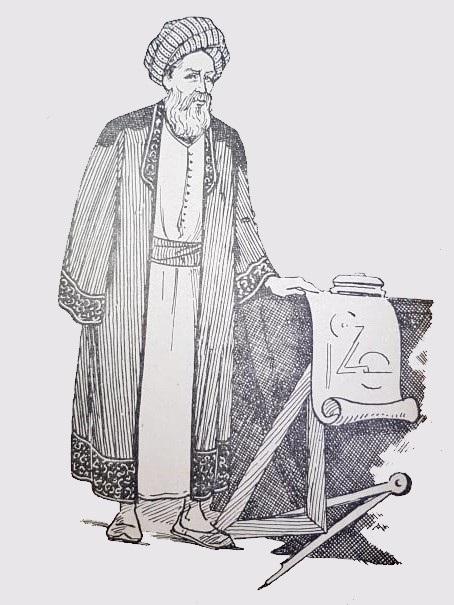
A drawn illustration of bearded man wearing a headdress and robes. He is standing, and has one hand rested on the clothed table beside him. In front of this are enlarged depictions of a wooden set square and a compass.
Credit
This work by Muhammad Atiyya Al-Ibrashi is licensed under Creative Commons Zero v1.0 Universal

Optics

Optics is an area of physics which looks at how light behaves and how we can observe it. 

This usually involves using mirrors and lenses to magnify, focus, and direct the path of light.

Image
There is an illustration of a bulging lens on the left. A dashed line runs through the centre across the image. Two red parallel lines hit the lens towards the top and bottom and then become diagonal, crossing paths at a point labelled "F" some distance after the lens. This distance is noted with a black arrow labelled "f'".
Credit
This work by JiPaul (based on work by Henrik) is licensed under Creative Commons Attribution Share Alike 4.0 International
Light (red lines) passing through a convex lens. The point at which the light meets (F') is called the focus. The distance from the lens to the focus (f') is called the focal length.

Waves

We are all familiar with waves; from ripples on the surface of a pond to the swell of the ocean. A wave is just a regular vibration that travels through something, like air or water. 

Image
Ripples on the surface of still water, caused by an object or disturbance, spreading out in concentric circles
Credit
This work by Pixabay is licensed under Creative Commons Zero v1.0 Universal

Light

When we talk about light we usually mean the light we can see with our eyes.

This is also called visible or optical light.

Light is one way energy can be transferred - moved from one place to another.

Image
A bright sun at the top of image, slightly off-centre, shines down over tall, thin trees with green foliage. The sky is bright blue with some white clouds visible.
Credit
This work by Emmanuel Huybrechts is licensed under Creative Commons Attribution 4.0 International

Gravitational Lensing

Space is not flat. It is 3D, and we say that everything in it is held together on an imaginary surface we call spacetime. The idea of spacetime was put forward in Einstein's theory of relativity.

Image
A white meshed grid against a black background. Three spheres of different size and mass sit on the grid, appearing to distort the grid beneath it. The largest sphere is yellow and causes the most distortion, with the next smallest being orange that causes less distortion. A red sphere is the smallest, with the mesh around it barely being distorted.
Credit
This work by ESA–C.Carreau is licensed under Creative Commons Zero v1.0 Universal
Artists impression visualising space-time being distorted by three spheres with different masses.