
Year born: 1950
Research Areas: Astrophysics, Pulsars, Geophysics, Magnetic Fields
Early Life
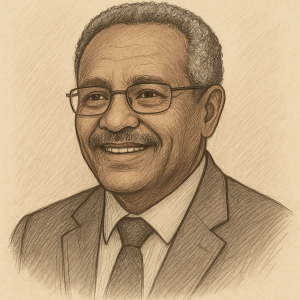
Legesse Wetro was born in Cire, a small town in Ethiopia. In 1967, he started studying physics at Addis Ababa University. There, he joined a Christian student group and enjoyed singing in the church choir. After his first degree in 1972, he stayed to teach physics. But Legesse wanted to learn more. He earned a master's degree from the University of Sheffield, UK, and a PhD in astrophysics from the University of California, US. Through all this time, he also wrote many gospel songs that people still enjoy today.
Career highlights
Legesse was one of the first people in Ethiopia to study astronomy in depth. He helped to start the country's Space Science Society and Space Science and Technology Institute. They later helped to launch Ethiopia's first satellite into space in 2019!
He studied very fast-spinning stars, called pulsars. His work helped to solve a 460-year-old puzzle about how Earth's magnetic field flips direction over time. He was named 'Man of the Year' in 2011 by the American Biographical Institute for this work.
Legesse was a founding member of many top science groups in Africa, like the African Astronomical Society. He was Ethiopia's representative to the International Astronomical Union and helped shape the field of science worldwide.
From 1998, he led the Astronomy and Astrophysics group at Addis Ababa University, inspiring many students. He even worked on a new method to find oil and gas using space-based data.
Legacy
Legesse helped bring space science to Ethiopia and Africa. He was a teacher and a leader who inspired young people to study the sky. His work changed how we think about stars and Earth's magnetic field. He passed away in 2017, having been a pioneer in astronomy in Africa. He played an important role in setting up science groups across the continent.
Other interests
Legesse had a deep love for music and faith. He sang in church choirs and solo. He wrote over 80 gospel songs about faith, hope, and worship. He stayed active in church all his life, often playing with his guitar and accordion. His music, like his science, touched the lives of many.