
For thousands of years, people around the world have looked to the sky for meaning. The Sun, Moon, stars, and planets helped mark time and seasons. They also inspired stories, beliefs, and rituals.
In many cultures, the sky was seen as sacred. Some people thought the stars were gods or messengers. Others used the movement of the heavens to set holy days or guide prayer. Astronomy became part of religion, worship, and even the design of temples.
This section explores how people have linked the sky with their faith and values. It shows how observing the heavens helped communities feel connected to something greater than themselves.
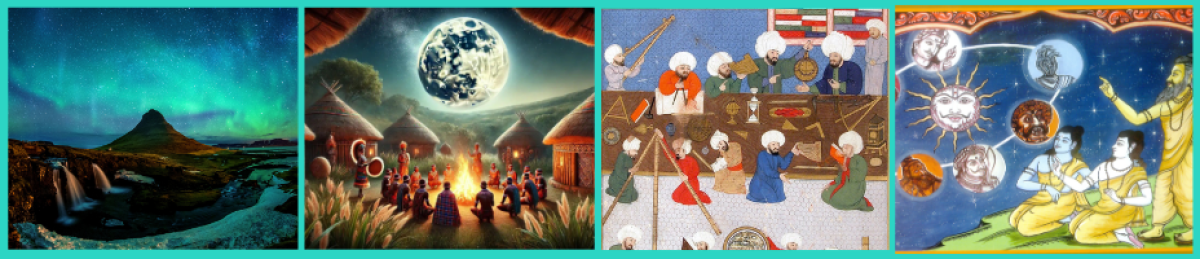
- Islamic Astronomy
In Islam, the sky has always been important for both faith and science. Astronomy helped people pray, fast, and celebrate at the right times. The Islamic calendar follows the Moon. Each month begins with the sighting of the new crescent. This is how Muslims mark Ramadan, Eid, and other holy days. Scholars studied the Moon and created rules to help decide when each month starts.
Muslims also need to know the qibla, the direction of Mecca for prayer. Astronomers worked this out using the Sun, stars, and maths. They built tools such as astrolabes and sundials to measure time and direction. Knowing when the Sun rises and sets was also vital for prayer times.
Muslim astronomers built observatories, made star charts, and wrote books about the planets. They questioned old ideas and made new discoveries. The work of scholars like Nasir al-Din al-Tusi later inspired European scientists. From Baghdad to Samarkand, observatories became centres of learning.
Islamic astronomy shows how science and belief can work together to help people understand both the heavens and their place on Earth.
Image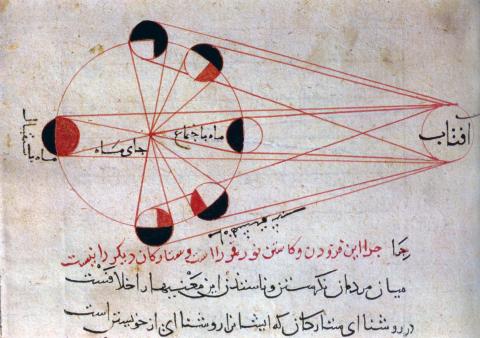 CreditThis work by Seyyed Hossein Nasr is licensed under GNU General Public License v2.0 or later
Illustration of different phases of the moon, from manuscript of the Kitab al-Tafhim by Al-Biruni (973-1048). - Jyotisha (India)
Jyotisha is the ancient Indian system of astronomy and astrology. The word means “light” or “heavenly body.” It is one of the oldest ways of studying the sky and is closely linked to Hindu belief.
Jyotisha divides the sky into 27 star groups, called nakshatras. The Moon passes through each group in about a day. People used these patterns to mark time, plan festivals, and guide daily life.
The Panchangam, or Hindu calendar, follows both the Sun and the Moon. It tells when to hold weddings, rituals, and celebrations. It includes sunrise and sunset times, Moon phases, and the positions of planets.
In Jyotisha, the grahas (planets) are believed to affect human life. Charts are drawn based on where the stars and planets were at birth. Some people use them for advice about health, work, or family. Others study Jyotisha for its maths and scientific ideas.
Indian astronomers such as Aryabhata and Bhaskara made great advances. They studied eclipses, planetary motion, and the shape of the Earth. Observatories like Jantar Mantar were built to measure time and track the sky.
Jyotisha shows how belief, maths, and science were joined together under one sky.
Image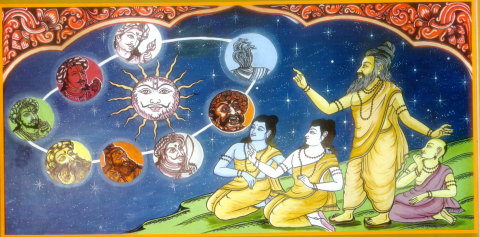 CreditThis work by Book "Sarwang" is licensed under GNU General Public License v2.0 or later
- Zulu & Xhosa Moon Lore (South Africa)
For the Zulu and Xhosa peoples, the Moon is full of meaning. It is not only a light in the sky but a guide for life, farming, and spirit. The phases of the Moon helped people know when to plant crops, hold festivals, or rest.
A full Moon might mean a time for song and story. A new Moon could mean quiet reflection. In traditional tales, the Moon is alive. Some say it was once a person. Others tell of battles between the Sun and Moon to explain eclipses.
The Zulu calendar follows the Moon’s cycle. Each month begins with the new Moon and has a name linked to the seasons or animals. One month might mean “when cows give birth,” another “when maize is ready.”
The Moon also plays a role in spiritual life. Some people pray or make offerings during certain phases. The Moon’s light is thought to bring peace or blessings.
Even today, many Zulu and Xhosa families watch the Moon to stay connected to their land and ancestors.
- The Zodiac and Astrology
The Zodiac is a band across the sky that follows what is known as the ecliptic. This is the path that the Sun, Moon and planets follow from our view on Earth. In ancient times, the Greeks and Babylonians split this band into 12 equal parts. Each was named after the most well-known constellations along the path. These 12 signs are what we know today as star signs or the signs of the Zodiac.
In astronomy, these mark regions of the night sky, but over time, ancient peoples across the world connected the sky to events here on Earth. For example, floods and droughts came at the same time each year, as did harvest time. Many animals also gave birth during specific moon phases. Over time, these links sparked a belief that we now call astrology.
Astronomy is all about exploring and understanding what happens in the Universe, like stars, planets, and galaxies. On the other hand, astrology looks at the movements of the stars and planets to find spiritual or personal meanings for people here on Earth. It’s a way for some people to connect what’s happening in the sky with their own lives. This may include predicting events or people's personalities based on where the stars appeared on the day of their birth.
Whilst thousands of years ago there was much crossover between the 2 topics, today they are seen as distinct areas. Astronomy is a science, and astrology is a belief system. Interestingly, because the Earth wobbles on its axis over time, the path of the Sun no longer matches the 12 star signs as it did when astrology was first created. But the belief that the movements of the stars and planets in the night sky connect to our lives on Earth remains strong.
Image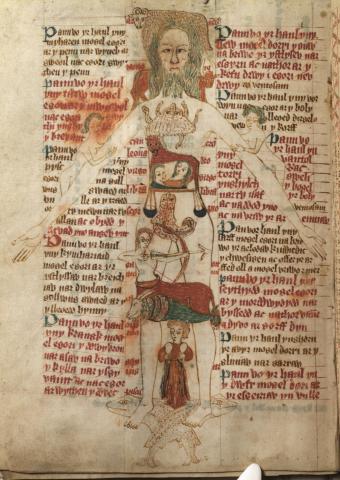 CreditThis work by National Library of Wales is licensed under Creative Commons Zero v1.0 Universal
Zodiac Man Visual representation of the correlation between the human body and the signs of the Zodiac.