
Occupation
Astronomer, Mathematician
Year Born
903
Research Areas
Stars, Star Maps
- Early Life
Al-Sufi was born on 7 December 903 in Rey, a city in what is now Iran. His full name was Abd al-Raḥmān al-Ṣūfī, but many people know him as Al-Sufi. He was one of nine famous Muslim astronomers. He lived during a time called the Islamic Golden Age when science, art, and learning were quickly developing.
From a young age, Al-Sufi loved looking at the stars and learning how the sky worked. He was also very good at maths, which helped him in his later work. His family likely supported his studies, and he grew up to be a curious and careful observer.
- Career Highlights
Al-Sufi became one of the most famous astronomers of his time. He worked at the Buyid court in Isfahan, where he was supported by leaders who valued science. He translated and added to works written by Greek astronomers. His most important book is The Book of Fixed Stars, written in 964. In it, he wrote about the stars and constellations and gave details about each star's size, brightness, and where it appeared in the sky.
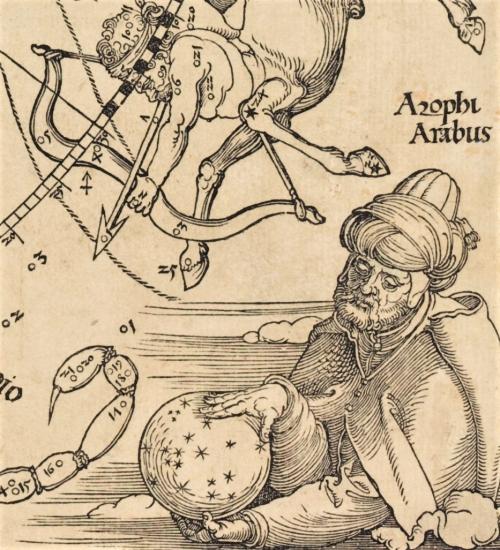
The Book of Fixed Stars describes 48 constellations, including the 12 zodiac signs, plus other star groups from the northern and southern skies. For every constellation, he would draw two pictures: how we see it from Earth and the view from space above the stars. The illustrations were mirror images of each other.
He also corrected mistakes made by earlier astronomers like Ptolemy, and he explained how Arabic star names matched with Greek ones. Al-Sufi was the first person ever to describe the Andromeda Galaxy, which he called a 'small cloud'. This was long before telescopes were invented!
Al-Sufi's work was very careful and full of detail. Many people used his book for hundreds of years. He helped connect the knowledge of ancient Greece with new ideas in the Muslim world.
- Legacy
Al-Sufi's ideas and drawings changed how people saw the sky. He helped make star charts more accurate and easier to understand. His work was used by scientists in the Islamic world and, later, in Europe.
Because of this huge impact, a crater on the Moon is named 'Azophi' (a version of his name), and even an asteroid was named after him - '12621 Alsufi'.
His careful study of the stars is one reason we know so much about the sky today. Many people admire his work more than 1000 years later!
- Other Interests
As well as being an astronomer, Al-Sufi was also a mathematician. He liked measuring things and used this passion to help him measure the stars better.
While we don't know much about his personal life or hobbies, it's clear he enjoyed learning and sharing knowledge, helping build a bridge between different cultures by bringing together ideas from Greek, Persian, and Arabic science.