
Occupation
Astronomer, Astrolabe Maker
Year born
~950 CE
Research Areas
Astrolabes
- Early Life
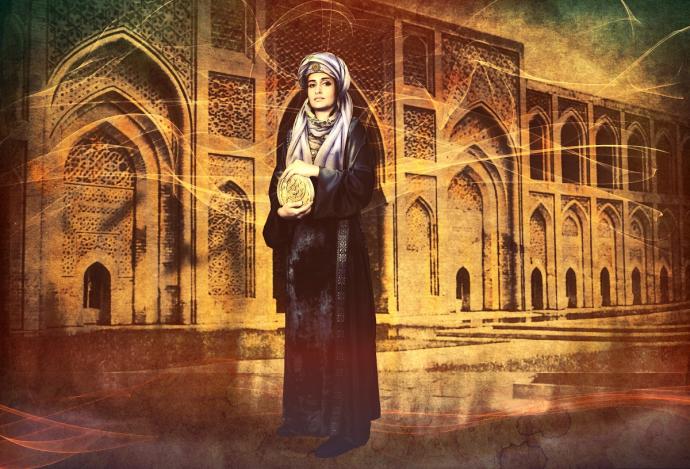
Al-Ijliya was born in the 10th century. She lived in Aleppo, a city in what is now Syria. She lived during a time when science and learning were highly valued across the Islamic World. There she learned a rare and important skill: how to make astrolabes. These were tools used to study the stars and tell time.
Her father was also a maker of astrolabes. He had learned from a famous craftsman named Nastulus, who worked in Baghdad. Al-Ijliya grew up watching her father work and later became his apprentice. Over time, she became skilled in metalwork, astronomy, and maths. This was rare because girls were not often taught these subjects. She finally worked alongside her father and made her own astrolabes, improving their design and accuracy.
- Career Highlights
Al-Ijliya became one of the few known women to work in science during the Islamic Golden Age. The tools she made were used to measure the position of the Sun and stars, tell time, and help with navigation. This was crucial for astronomy, religion, and travel. Muslim scholars used them to find the direction of Mecca and to plan prayer times.
Her work was so skilled and well known that Sayf al-Dawla, the ruler of Aleppo, invited her to work at his court. This was a great honour. He supported scientists, poets, and inventors. By joining his court, Al-Ijliya became part of a group of the most brilliant minds of her time.
At the court, she didn't just copy old designs; she improved them. Her astrolabes were known for their great detail and accuracy. This made them more helpful for tasks such as map-making, building tall structures, and navigating at sea.
Working in a royal court as a scientist was rare for women at the time. Her career shows us that women are a vital part of scientific progress, even if they were not always spoken about in the history books. Al-Ijliya's achievements remind us that passion and skill can sometimes break barriers.
- Legacy
Her name may not have been remembered for many centuries, but in recent years, her story has inspired new generations. In 1990, an American astronomer named an asteroid after her, 7060 Al-Ijliya, as a way to honour her work in astronomy.
She has also appeared in books and shows. The main character of the science fiction book Binti was based on her. Even Netflix's Vikings: Valhalla featured a character inspired by Al-Ijliya. She has been recognised by '1001 Inventions', a group that celebrates science from the Islamic world, as an inspiring woman from history.
Although we know very little about her life, the impact of her work continues. She shows us that science has always included people of many backgrounds, working with care and skill behind the scenes.
- Other Interests
From what we can gather, Al-Ijliya had a strong interest in craftsmanship. Making an astrolabe wasn't just about science; it also took a lot of skill with metal tools and artistic design. They were decorated with stars, numbers, and even verses from the Qur'an; it's likely she cared very much about the beauty of the objects she made.