
Occupation
Astronomer, Mathematician
Year Born
476
Research Areas
Planetary Motion, Eclipses, Rotation of Earth, Geometry, Trigonometry
"Just as a man in a boat moving forward sees the stationary objects (on either side of the river) as moving backward, just so are the stationary stars seen by people at Lanka (on the equator), as moving exactly towards the west."
Source: Aryabhata, 'Aryabhatiya', Golapada 9 - 10, Translated by K. S. Shukla and K.V. Sarma, K. V., New Delhi: Indian National Science Academy, Āryabhaṭīya of Āryabhaṭa (1976), page 119.
- Early Life
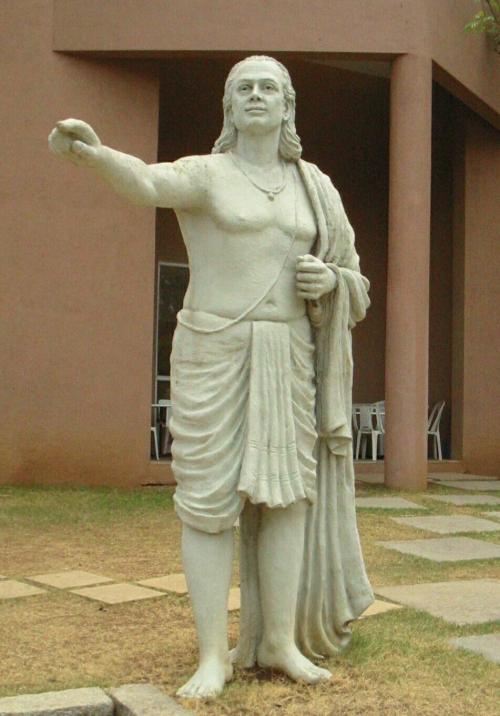
Aryabhata was born in the year 476 in India. We are not exactly sure where. Some people think it was a place called Ashmaka in the south, while others believe he was from Kusumapura, which was a big centre for learning at the time.
This was during the Gupta Empire, a time when art, science, and learning were quickly developing in India. Aryabata was very curious and smart. He began studying maths and stars at a young age.
- Career Highlights
Aryabhata was one of the first great mathematicians and astronomers in India whose work we still know today. His most famous book, Aryabhatiya, was written in the year 499 when he was 23 years old. It covered math and astronomy in verse form.
There were four main parts: Gitika (time and motion), Ganita (maths), Kalakriya (Hindu months and days of the week), and Gola (spherical astronomy, celestial bodies, and the rotation of the Earth).
Aryabhata worked on square and cube roots, geometry, and algebra. He used a very accurate value for pi, writing it as 3.1415. This is very close to today's value. He also created a clever number system using letters instead of digits, which could show very large numbers.
Aryabhata studied the movement of the planets and stars. He said that the Earth spins on its axis, and that is why the stars seem to move across the sky. This idea was far ahead of its time. He calculated the sidereal rotation of the Earth (how long it takes for one rotation on its axis, using background stars as a fixed reference). His value was only 0.009 seconds more than the accepted value we use today.
He also explained that the Moon and planets shine because they reflect sunlight. He understood how eclipses occur and explained that they are caused by shadows, not monsters, as some people believed at the time.
He wrote other works as well. Though these are now lost, they helped spread his ideas to other parts of India and, even beyond, to Islamic scholars in the Middle East. His ideas shaped science for many centuries.
- Legacy
Aryabhata changed how people thought about numbers, time, and space.
He helped develop the decimal number system, which is still used today. His methods for solving tricky maths problems inspired many Indian scholars who came after him. His clear ideas about the Earth spinning and the real cause of eclipses showed deep understanding, even though they were not widely accepted at the time.
Aryabhata's influence wasn't limited to India. His work reached scholars in the Islamic world, where it helped shape astronomy and maths in the Middle Ages.
In 1975, India named its first satellite 'Aryabhata' to honour his great mind. There is also a crater on the Moon named after him, as well as a species of bacteria discovered in the Earth's atmosphere by Indian space research scientists in 2009. There are even a few educational institutes in India that include his name.
- Other Interests
While we mostly remember Aryabhata for his maths and astronomy, he was interested in timekeeping and how the heavens affect daily life.
He explored how to measure time using stars and planets. He also studied the best times to do certain things based on the positions of the stars. This was a mix of science and astrology.
He liked to write in verse, using short poems to share complex ideas. This made it easier for students to learn and remember his work.