
Occupation
Mathematician, Astronomer, Geographer
Year Born
around 780
Research Areas
Algebra, Arithmetic
"When I considered what people generally want in calculating, I found that it always is a number."
Source: Al-Khwarizmi, 'The Compendious Book on Calculation by Completion and Balancing', translator: Frederic Rosen (1831).
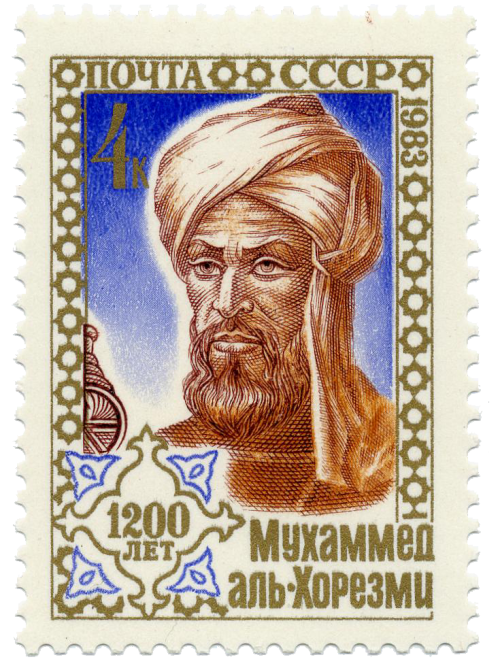
- Early Life
Al-Khwarizmi was born around 780 in a place called Khwarizm, which is now partly in Uzbekistan and Turkmenistan. Little is known about his early years, but he later moved to Baghdad, Iraq.
At that time, Baghdad was one of the world's smartest cities. It had a huge library and research centre called the House of Wisdom. Many clever people from different countries worked there. They studied books from all over the world, especially from Greece, India, and Persia.
Al-Khwarzimi was one of the top thinkers there. He loved numbers, stars, and maps. He worked hard to learn from texts and then added his own great ideas.
- Career Highlights
Al-Khwarizmi became famous for his work in mathematics, especially algebra. He wrote a book in Arabic called Al-Kitab al-Mukhtasar fi Hisab al-Jabr wal-Muqabala, which means The Compendious Book on Calculation by Completion and Balancing.
It showed new ways to solve equations. No one in Europe had seen anything like it before. His book was later translated into Latin. That's when the word 'algebra' was born from the Arabic word 'al-jabr'.
He also wrote a book on numbers called Kitab al-Jam'a wal-Tafreeq bil Hisab al-Hindi, which means The Book of Addition and Subtraction using Indian Numbers. This helped introduce Hindu-Arabic numerals to Europe, including the concept of the number zero.
These numbers were easier than Roman Numerals and helped with trade and science. At first, people didn't like them. In some places, they were even banned! But in time, they became the way everyone did maths.
His name in Latin, 'Algorismus', gave us the word 'algorithm', which is the step-by-step method we use in computers today. His ideas helped build the world of modern science, maths, and even technology.
- Legacy
Al-Khwarizmi's work changed the world. His algebra book was used in European schools and universities for hundreds of years. His ideas helped other scientists explore space, design buildings, and make tools. Without him, we wouldn't have easy maths, science, or even computers as we know them.
His number system made things like banking and engineering much faster and more efficient. Every time we use a calculator, computer, or phone, we are using his ideas. The word 'algorithm' is used in almost every field today, from maths to music apps.
Al-Khwarizmi is remembered as one of the most important scientists and mathematicians of all time. There are sculptures and statues of him in many places, a crater on the Moon called after him, and two asteroids with versions of his name.
- Other Interests
Al-Khwarizmi didn't just work on maths. He also studied the stars, the Earth, and how time works. He wrote about sundials, clocks, and how to use stars to find your way. He helped make better maps and even wrote a geography book. He also helped improve tools like the astrolabe, which travellers and astronomers used. He even studied calendars and wrote about the Jewish calendar.
Al-Khwarizmi was always curious. He looked for answers in everything around him. His love for learning helped shape the world we live in today.