
Occupation
Astronomer, Ruler
Year Born
around 1394
Research Areas
Astronomy, trigonometry, and spherical geometry
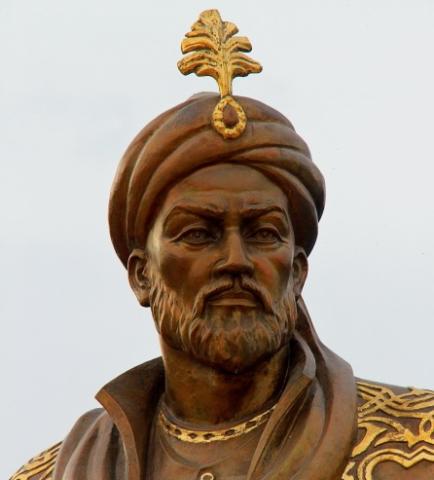
- Early Life
Mīrzā Muhammad Tarāghāy bin Shāhrukh better known as Ulugh Beg. He was born in 1394 in a place called Soltaniyeh, Persia, which is now in Iran. He was the grandson of the great conqueror Timur, also known as Tamerlane.
As a child, Ulugh Beg travelled with Timur's army and court. This gave him a chance to see many different places and cultures. He once visited the ruins of the Marāgha Observatory. This sparked his interest in Astronomy from a young age.
When he was still a teenager, his father, Shah Rukh, made him the ruler of Samarkand. He was only 16 years old at the time. Unlike his grandfather and father, Ulugh Beg wasn't interested in war. He loved learning. He wanted Samarkand to become a great centre of science and culture. That dream would shape the rest of his life.
- Career Highlights
Ulugh Beg was more than just a ruler, he was a scientist. He especially loved astronomy and mathematics.
In 1417, he built a school in Samarkand called a madrasah. It became one of the most famous places of learning in the world. He invited many top scientists, like al-Kashi and Qadi Zada, to teach and study there.
In 1428, Ulugh Beg built a giant observatory. It was one of the best in the world at the time. It had very large tools, including a massive marble sextant, to help measure the positions of stars and planets. Scientists working there, under Ulugh Beg's guidance, made very accurate observations of the sky.
Ulugh Beg created a star catalogue called the Zij-i Sultani. It listed 992 stars and was the best of its kind since the time of Ptolemy. His team also created extremely accurate trigonometry tables. His value for the sine of 1° was correct to many decimal places, almost the same as we use today! He even calculated the length of the year within less than a minute of today's value.
Thanks to Ulugh Beg, Samarkand became one of the world's most important places for science in the 1400s.
- Legacy
Ulugh Beg's legacy is not in battles, but in books and stars. He showed that a ruler could love learning more than war.
His observatory and school helped spark new discoveries in astronomy and mathematics. His star catalogue was used for hundreds of years. Even today, scientists admire how accurate his work was.
Ulugh Beg is remembered as one of the greatest astronomers of the Islamic Golden Age. His work helped build a bridge between ancient and modern science.
- Other Interests
Ulugh Beg had many other interests beyond science. He enjoyed writing poetry and studying history. He also read and studied the Qur'an.
Ulugh Beg believed that learning about art, religion, and science could make a person truly wise. He built libraries and supported artists as well as scientists. His court in Samarkand was full of thinkers, poets, and scholars.