
Occupation
Astronomer, Mathematician
Year Born
around 858
Research Areas
Stars, Star Maps, Solar and Lunar Motion, Trigonometry
- Early Life
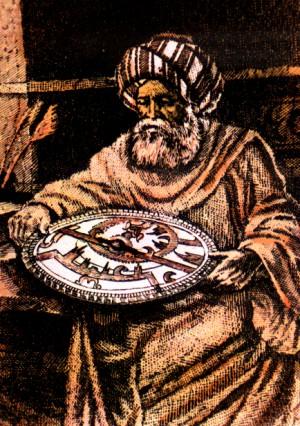
Al-Battani was born around the year 858 in Harran, a town located in what is now modern-day Turkey. He came from a family known for science and learning. His father made tools used to study the stars, and he likely taught young al-Battani how to use and build these instruments.
Although his family came from a group called the Sabians, who worshipped stars, al-Battani was a Muslim. He had a deep interest in space, numbers, and how the sky worked.
As a young man, he moved to the city of Raqqa in Syria. There, he studied hard and became a respected scholar. He would go on to become one of the greatest astronomers of his time.
- Career Highlights
Al-Battani spent much of his life watching the sky and making careful notes. He worked in cities like Raqqa and Antioch, where he used special tools to study the Sun, Moon, and planets. In Antioch, he watched a solar eclipse and a lunar eclipse, but most of his observations happened in Raqqa. He recorded his findings over a period of more than 40 years, and the large instruments he used made his data very accurate. He wrote about his methods, which allowed others to try them out and replicate his results.
He noticed that the distance from the Earth to the Sun changes during the year. This helped him realise why annular solar eclipses happen. His calculated value for the solar year was only 2 minutes and 22 seconds shorter than the value used today (365 days, 5 hours, 48 minutes, and 46 seconds). He also measured how the Earth's axis itself is slowly rotating and causing the stars to slowly move in their positions, which is now known as Earth's precession.
Al-Battani didn't just copy what earlier scientists like Ptolemy had said. He checked their work using his own observations. When he found mistakes, he corrected them. He was one of the first to use trigonometry instead of just geometry to study the sky. That was a big step forward for science.
His most famous book, Kitab al-Zij, had 57 chapters. It included star maps, math tools, and tables to help predict things like eclipses. This book was so good that it was translated into Latin and used in Europe for hundreds of years. Even famous scientists like Copernicus, Kepler, and Galileo used his work to build their own ideas.
- Legacy
Al-Battani is remembered as one of the greatest astronomers and mathematicians of the Islamic Golden Age. His work was more accurate than many that came before him. Thanks to his careful records and smart methods, other scientists were able to make new discoveries later on. His work was even used to improve calendars to the one we use today.
He was one of the first to use trigonometry to solve space problems, which helped shape how modern astronomy works. His book, Kitab al-Zij, was translated in the 1100s and helped shape astronomy in Europe. Later, scientists built off his work.
Today, a crater on the Moon is named 'Albategnius' (a version of his name) in his honour. It shows the importance of his work - not just in his own time, but for the future of science and space studies.
- Other Interests
Al-Battani also studied astrology, which was common at the time. He even wrote about how to build sundials and tools to track the movement of the stars and planets.
In his later years, he also became involved in public life and went on a trip to Baghdad to help his community with tax issues.