
People everywhere have looked up at the night sky for thousands of years, wondering what they could see. The stars have helped people find their way, tell the time of year, and dream about the Universe.
But the sky is more than just stars and planets. It's full of stories! Every culture around the world has made up its own tales about the shapes and patterns in the sky. These stories help people explain what they see and feel connected to the world above them.

- Emu in the sky (Dhinawan Mulaa Wir-ra)
The first people of Australia had many stories about the night sky. These are woven through their culture and dreamtime stories. These are ancient tales passed down through the generations, which explain their view on the creation of the world and myths and stories of spirits.
One such story is that of the Emu (Gugurmin). The Emu in the Sky is a constellation in the night sky, not made of connected stars but instead of the dark patches of the Milky Way galaxy. These dark patches are clouds of dust and gas within our galaxy —the stuff new stars are made of. But they are so thick that they block out the light of the background stars, making dark patches across the galaxy.
The main band of the Milky Way, with these dust lanes, is not visible all year. In the Southern hemisphere, it acts as a seasonal calendar. In some Aboriginal communities, such as the Kamilaroi, Wiradjuri, and Boorong peoples, there are stories of the Emu in the Sky.
Made by joining dark patches beneath the Southern Cross. We now know the head of the Emu as the Coalsack Nebula.
Image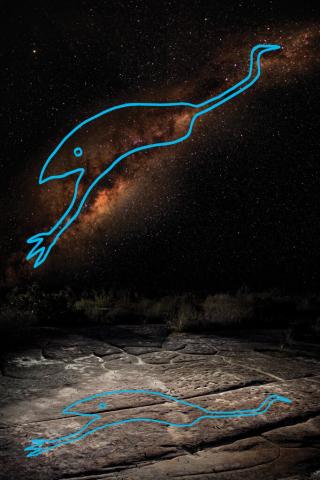 CreditThis work by Barnaby Norris & Ray Norris is licensed under Creative Commons Attribution Non Commercial Share Alike 4.0 International
When the emu appears clearly in the evening sky between March and May, it signals that emu eggs can be collected as an important food source. This mirrors the emu's mating season on Earth, when the females chase the males. As the season changes, the emu appears to move closer to the horizon, with the head pointing down. This reflects the time when the male emu sits, nesting on the eggs. This was a sign that no more eggs should be collected as the chicks are being incubated. Aboriginal codes always stress leaving some for nature, to maintain balance in the world and to give the emu a chance to create a new generation for future seasons.
Rock carvings of the emu, reflecting its position in the sky during these times, have been found throughout Australia. The image on this page shows the rock carvings in Kuring-Gai Chase National Park near Sydney.
There are more examples of 'dark' constellations within the Milky Way from the Inca people who saw a llama, fox, toad and serpent hidden among the dust lanes.
- Stories of Vega and Altair
There are many stories linking the bright stars of Vega and Altair. They appear high in the summer sky in the Northern hemisphere. However, they can also be seen lower on the horizon in the Southern hemisphere during this time.
In western astronomy, the stars have been grouped with one called Deneb. Here, all 3 stars are in different constellations, but together they form the summer triangle. This is one of the brightest star patterns in the night sky. This triangle surrounds a section of the Milky Way galaxy, which we see packed with stars. When the triangle is high overhead, it marks summertime.
However, stories in the stars are different as you move around the world. The same stars can create new patterns and stories as we move from one culture to another.
In Chinese and Japanese astronomy, the stars Vega and Altair are closely linked in the story of the Weaver Girl and the Cowherd Boy.
There are different versions of the story, but most have the fact in common that Vega was a princess of the sky who fell in love with a mortal man, Altair. The 2 were banned from being together, but they could not stop loving each other. Altair was turned into a star in the night sky, like Vega, but Vega's parents separated them forever with a huge heavenly river —the Milky Way.
The story goes that once a year, the two can visit each other when a bridge of magpies appears across the river. This day is marked by festivals in both countries today.
Image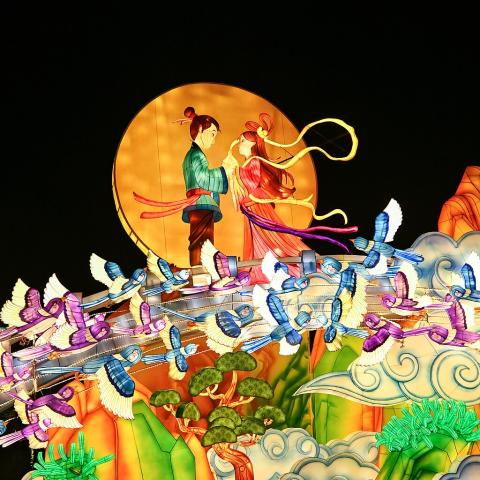 CreditThis work by ScribblingGeek is licensed under Creative Commons Attribution Share Alike 4.0 International
- Pleiades across cultures
The Pleiades is a small, young cluster of around 1,000 stars which can be easily seen in the night sky. It is clear to see, as it is close to Earth, and because the stars are young, they are bright and blue. Using our eyes, we can count at least 6 of these stars, but with the darkest skies and the best eyesight, up to 12.
The cluster can be seen around the world from November to March (a little longer in Southern skies). Its brightness, close grouping of stars, and visibility all over the world mean that, over time, it has appeared in many different cultural stories.
Image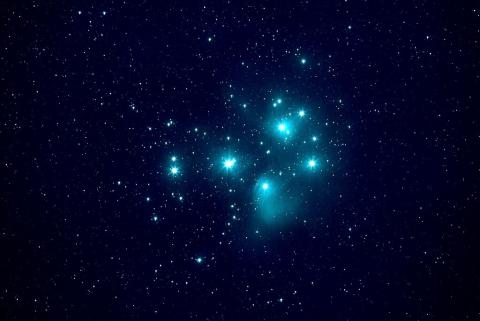 CreditThis work by Juan lacruz is licensed under Creative Commons Attribution Share Alike 4.0 International
Some of the stories of the Pleiades tell a very similar tale, even across ancient cultures that may never have interacted with each other when the stories were first told.
Many stories refer to the star cluster as 7 young women, sometimes sisters. For example, the historically nomadic Tuareg Berber people of Northern Africa call the constellation Cat iheḍ, meaning daughters of the night. Sayings in the community link the cluster's position in the sky with seasonal changes around the Sahara.
In stories from the Kiowa and Lakota people of North America, a group of 7 young girls was chased by a bear through the rocks and trees by their village. As they grew weary, they prayed to the great spirit for help, and the rock they were standing on lifted them high into the skies away from the bear. There they became star people, forever in the skies. Each winter, the Pleiades rise over the rock (now called The Bear's Lodge) in the middle of the night, and the story is remembered.
There are many, many other stories across cultures, such as those of the ancient Greeks, many Aboriginal groups, the Japanese, the Māori, and the Mesopotamians. In New Zealand (Aotearoa), the cluster can be seen for most of the year, except for a single month in winter. For Māori people, it's return to the sky in late June/early July that indicated the start of the new year. The Pleiades have long inspired stories. Many of these stories connect the position of the star cluster with a time for harvest, or seasonal changes.
An interesting fact is that so many of these stories describe seeing 7 bright stars, but today it is only possible to see 6 clearly. This may mean that many of the stories of the Pleiades we have today come from very ancient times, when, in fact, 7 stars were visible; over time, 2 of them are now hard to separate. Another reason could that one of the stars changes in brightness, meaning it isn't always visible. The star might also have been the planet Venus passing through the same region of sky during points in its orbit.
- The Milky Way - Pathway in the heavens
In many cultures, the stars are not the only connection to stories. Much like the Emu in the Sky, many Polynesian cultures also looked to the Milky Way galaxy for a connection between Earth and something bigger.
In Hawaiian traditions, the Milky Way has several names, including Ka‘āhelelani, The Heavenly Procession. It was important for wayfinding, as it directed sailors east-west across the seas and helped them find other important navigational stars.
These navigational ties were also important in Tahiti, where the Milky Way or Te Ara o Te Ra'i (Pathway to heaven) connected real-world travel with travel between worlds. The band of light was seen as a bridge between the Earth and spirits or ancestors.
The otherworldly connection can also be seen in Samoan and Tongan traditions, which refer to the galaxy as Auala o Aitu or The Road of Spirits, where the souls of the dead would travel to the afterlife over the western horizon.
In many of these traditions, the Milky Way was seen as a reflection of the sea. Its position at different times of year was linked to changes in sea conditions - when it arched high in the night sky, it was a time of calm seas. It also held the stories of connecting life on Earth to something beyond what we can see.
Image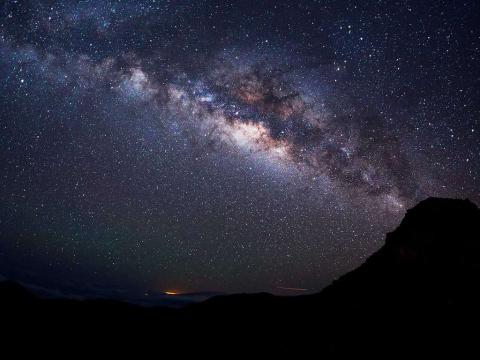 CreditThis work by National Parks Gallery is licensed under GNU General Public License v2.0 or later
- Sun and Moon - Giver of Life and Keeper of Time
In many cultures, such as the Pedi people of South Africa and the Sandawe people of Tanzania, the most notable things in our sky—the Sun and Moon—also had much greater value. Many ancient cultures had a more connected relationship to nature, the Earth and the skies than many people have today.
The Sun was seen (accurately) as the source of life, order and warmth. The Pedi know the Sun as Letsatsi, with its rising and setting marking points for daily rituals. The light and heat from the Sun were seen as symbols of life and goodness, and the first light was considered the best time to plant crops or begin celebrations. For the Sandawe people, the rising of the Sun also marked the start of the day for hunting and working. Sunset was a time for rest and storytelling. The path the Sun took across the sky also connected the journey of spirits passing from the world of the living to the ancestral world.
The Moon was important for timing. Known as Ngwedi among the Pedi, it was used to measure months and farming seasons. The waxing Moon marks the time to plant seeds, and the waning Moon the time to harvest crops. To the Sandawe people, the Moon's phases were also bonded to the right time to plant crops, hunt or gather honey. The new Moon was a time of renewal, and the full Moon was a time for celebration.
Image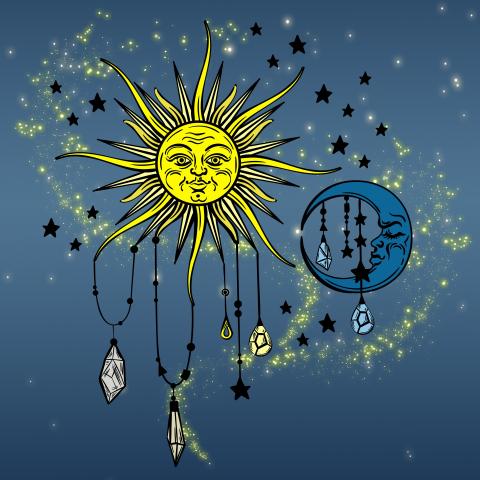 CreditThis work by Circe Denyer is licensed under GNU General Public License v2.0 or later
The Sun and Moon together represent the balance of light and dark, and of male and female energy.
This is also a theme of the Yorùbá people of West Africa. The stories say that the Sun (Òòrùn) and Moon (Òṣùpá) were husband and wife. The Sun is strong but proud, and the Moon is gentle and patient. When the couple had arguments, the Moon would retreat (in line with the new moon phase). Eclipses in the sky meant the couple made up with a short embrace in the sky.
- Aurora - Dancing Lights
Around the world, the aurora have long sparked imagination, and there are lots of stories describing these strange lights in the sky. Today, we know that the lights are caused by charged particles from the Sun entering Earth's atmosphere and being carried along the magnetic field lines to the poles.
Some of the richest cultural stories of the aurora come from the Inuit indigenous peoples of North America. In these communities, winter brought 24 hours of darkness, making the arrival of the northern lights, or aurora borealis, common.
Image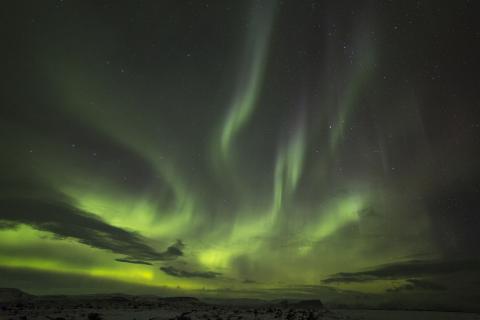 CreditThis work by AstroAnthony is licensed under Creative Commons Attribution 4.0 International
Although there are different stories of the aurora across different Inuit communities, many have in common that the lights were seen as the spirits of people who had passed on. Here, they would play or dance in the sky. The arrival was comforting to most of these communities, showing that their loved ones were still close.
Many of the Inuit communities that shared this legend told of happy spirits moving with the twists and waves of the aurorae. The faster the lights moved, the happier and livelier their spirits; when they looked fainter or stiller, their spirits were resting or watching quietly.
Some of the stories of the games the spirits played include a ball game using a walrus skull as the ball, being kicked around in the sky!

