
Occupation
Astronomer, Educator, Poet
Year born
around 1690
Research Areas
Comets, Mathematics, Classical Studies, Education
"For the World is also bounded
by the heavens and Stars above
Why should We then be confounded
Since there's nothing free but Jove"
Source: Williams, Francis. Excerpt from 'Welcome, welcome Brother Debtor'.
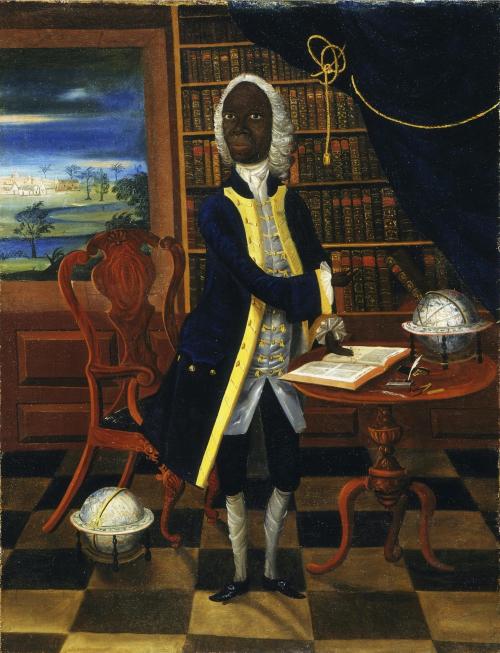
- Early Life
Francis Williams was born around 1690 in Kingston, Jamaica. He was a free black man at a time when many people of African descent were enslaved. His parents, John and Dorothy Williams, were also free and owned land. This gave Francis the chance to learn and grow in ways others could not.
His father wanted Francis to get a strong education, so he sent him to England. There, Francis studied reading, writing, maths, and Latin. Some say he went to the University of Cambridge, but there's no clear proof. Still, he became very clever and skilled.
He befriended many scientists and was allowed to attend meetings of the Royal Society, an organisation that promotes and supports science. In 1716, when Williams was in his early twenties, he was nominated to become a fellow of the Royal Society. This award is given to those who make important contributions to science. But Williams was denied a fellowship due to his race.
- Career Highlights
After returning to Jamaica in the 1720s, Francis Williams started a school for free black children in Spanish Town. This was very rare at the time. He taught reading, writing, Latin and maths. Williams believed that education could help fight against unfair ideas about black people. He wanted to show that black people were just as smart and capable as white people. His school helped many children to learn and grow.
Francis Williams also became a well-known poet. He wrote in Latin, which was considered a language of the highly educated. His most famous poem was written for George Haldane, a British governor in Jamaica. He also wrote poems that showed pride in his race and culture. His work helped challenge racist views and proved that anybody could be a great thinker and artist. His life was a powerful example of how learning can be a tool for freedom and respect.
In 2024, an academic named Fara Dabhoiwala took a look at the famous painting of Francis Williams. Using scans and X-rays, he found something surprising - many signs pointing to Williams's involvement in calculating Halley's Comet trajectory. Fara noticed one of the books behind Williams was only published in 1955, years after the painting was originally dated (around 1735 or 1740). This is important as Halley's Comet was visible over Jamaica in 1759.
Another clue is that Williams has his hand upon Isaac Newton's Principia. His series of books included complex mathematics that many struggled to understand. Lots of scientists added Principia in their own painted portraits to demonstrate their intellect and relationship to Newton. Fara saw that the book was open on page 521. Only Book 3 of Principia was that long, and the page itself details how to calculate the orbit of a returning comet.
The study of the painting showed that Williams likely paid for the portrait to be made himself around the year 1760. He may have done this to mark a big achievement - his work tracking the path of Halley's Comet over Jamaica in 1759. Before this, no one had given him credit for helping prove the comet would return, something Edmund Halley had predicted. Thanks to this new research, it's now believed Francis Williams may have played an important role in this piece of history.
- Legacy
Francis Williams is remembered as one of the first known black scholars and poets in the British colonies. He helped prove that people of African descent can succeed in school and the arts. This was very important during a time when slavery and racism were common.
His portrait, painted whilst he was alive, still exists today and is on display in London. It shows him as a proud, educated man with books and symbols of learning. The portrait also shows that he had observed the return of Halley's Comet, confirming Newton's laws of motion. That picture - and his life - help inspire people even now. His work helped open doors for future black writers, teachers, and students.
The asteroid '20610 Franciswilliams' is named after him.
- Other Interests
Besides writing and teaching, Williams enjoyed classical books, history and numbers. He studied Latin poetry, which takes a lot of thought.
He also loved maths; he was a deep thinker.