
Occupation
Astronomer, Mathematician, Physicist
Year Born
around 965
Research Areas
Optics, Vision, Geometry, Planetary Motion, Scientific Method
"Therefore, the seeker after the truth is not one who studies the writings of the ancients and, following his natural disposition, puts his trust in them, but rather the one who suspects his faith in them and questions what he gathers from them..."
Source: Ibn al-Haytham, 'The Optics of Ibn al-Haytham. Books I–II–III: On Direct Vision' (translator: Sabra, A. I., London: The Warburg Institute, University of London).
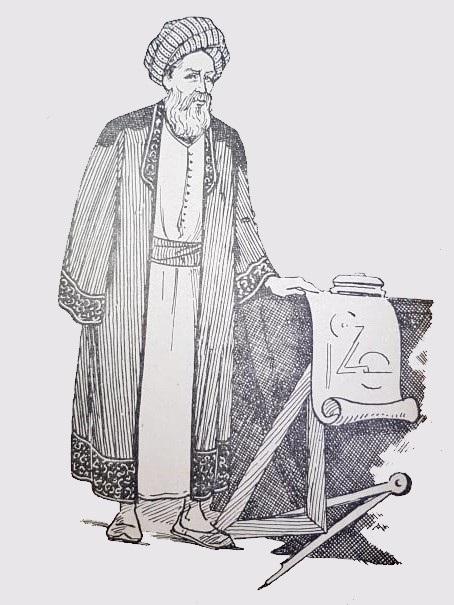
- Early Life
Ibn al-Haytham was born around 965 in Basra, a city in modern-day Iraq. He lived during the Islamic Golden Age, a time full of progress in science, medicine, and art. Scholars of many cultures worked together, building on knowledge from ancient Greece, Egypt, India, and China.
From a young age, Ibn al-Haytham loved to ask questions and solve problems. He read many books and was especially interested in how we see and how light works. His clever ideas made him famous. The ruler of Egypt invited him to help build a dam on the Nile River. But after studying the land, Ibn decided it couldn't be done safely.
Fearing punishment, he pretended to be mad and was placed under house arrest for years. But, even in this quiet time when he was locked away, he kept thinking. It was during this period that he began working on his most famous ideas!
- Career Highlights
Ibn al-Haytham is remembered most for changing how we understand vision and light. Before him, people thought we saw objects because light rays came from our eyes. Others believed light entered the eye, but no one had tested it properly. Ibn was the first to prove, with experiments, that light travels in straight lines and enters the eye, allowing us to see.
Ibn al-Haytham didn't just guess. He believed ideas must be tested using experiments or mathematical solutions. Though this was a new way of thinking at the time, it is now known as the scientific method - a way of doing science that tries to get the most accurate results.
Ibn used lenses, mirrors, and shadows to study how light reflects (bounces off objects), refracts (bends and changes direction), and forms images. He studied how light bends in water and glass and explained why things look bigger underwater. He observed a partial solar eclipse using a camera obscura, which forms an upside-down image on a surface when light passes through a small hole opposite. He also noticed how reflected light from an object can change colour depending on the object's colour.
As well as understanding the physics of light, Ibn al-Haytham thought about why we might see things a certain way. One example of this was his explanation about how the Moon appears larger when it is closer to the horizon compared to overhead. Many believed the Moon looked bigger due to the bending of light rays. But Ibn argued that it was an optical illusion of sorts. The Moon only looked bigger because, on the horizon, there are objects (like buildings) to compare its size to.
Ibn al-Haytham wrote many books to explain his ideas and experiments. His most famous work, Kitab al-Manazir or Book of Optics, was written while under house arrest. He described how the eye works, naming parts like the lens, retina, and cornea. He even drew one of the first diagrams of the nervous system.
- Legacy
Ibn al-Haytham changed science forever. He proved that careful thinking and experimentation could unlock the secrets of nature! This helped shape the way modern scientists work today. His ideas spread far beyond the Arab world.
After he died in 1040, many of his books were translated into Latin. European scientists read his work for centuries. His Book of Optics helped shape the fields of vision, light, and psychology. In modern day, some even call him the 'Father of Optics' because of how influential his work became.
In fact, some of his ideas remained important for hundreds of years. One of his puzzles, how light reflects off curved mirrors, was not fully solved until 1997!
A crater on the Moon and even an asteroid were named after him: 'Alhazen' (a version of his name).
- Other Interests
Ibn al-Haytham didn't only study light. He was interested in math, astronomy, engineering, medicine, and more. He wrote at least 96 books, though only 55 have survived. In them, he explored things like rainbows, eclipses, and even how we see shadows.
He also studied topics in astronomy, such as the motion of the planets, and built models using physical objects to attempt explanations and test out theories.
Ibn's wide range of interests shows how curious and thoughtful he was. He used logic, maths, and hands-on testing in everything he did. For him, science was not just a job; it was a way to discover the truth.