
Occupation
Astronomer, Mathematician, Philosopher, Scientist
Year Born
1201
Research Areas
Planetary Motion, Star Maps, Trigonometry, Logic, Ethics
"The fundamentals of Mathematics are of four kinds: ... third, knowledge of the different stations of the higher bodies relative to each other and to the lower bodies, and the measurements of their motions and their distances, and this is called Astronomy ... "
Source: Nasir ad-Din Tusi (1964) The Nasirean Ethics (translator: G.M. Wickens). London: Allen & Unwin, 27.
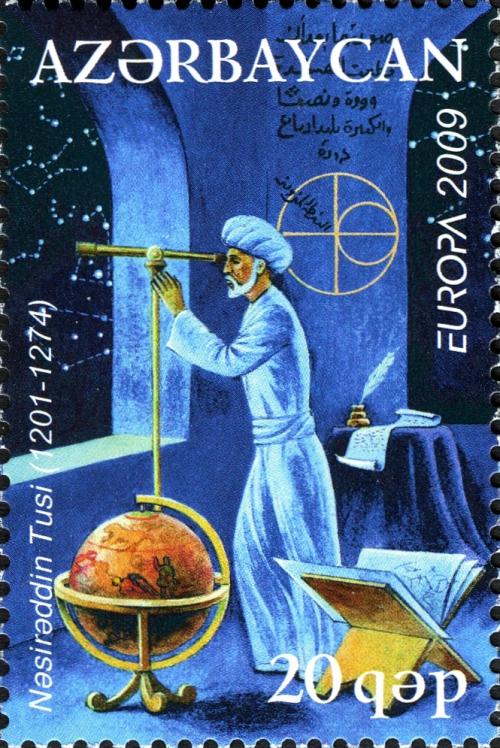
- Early Life
Nasir al-Din al-Tusi was born on 18th February 1201, in the ancient city of Tus. This historical site was located in what is now modern-day Iran. His father was a religious teacher in the Twelfth Imam School, which followed Shi'ite Islam.
While learning religion, al-Tusi also studied logic, physics, and maths. His uncle helped him learn subjects beyond the usual religious topics. As a young man, al-Tusi moved to the city of Nishapur. It was a great place for learning. There, he studied philosophy, medicine, and advanced maths. He quickly became known for his clever mind.
But his world was changing. The Mongols, led by Genghis Khan, were invading. War and unrest were everywhere. Al-Tusi had to adapt to survive in a dangerous time.
- Career Highlights
During the Mongol invasions, al-Tusi joined a group called the Assassins, who lived in mountain forts. He wrote many books while living with them, including a famous one on ethics.
Later, when the Mongols took over their fort in 1256, al-Tusi joined the Mongols. He became an advisor to Hulagu Khan, the Mongol leader, and helped with religious and scientific matters. Al-Tusi's biggest project was building an observatory in Maragheh. With support from the Mongols, the observatory was completed in 1262.
It became a major science centre. Many renowned scientists helped to make instruments and carry out observations. Students travelled from far away to study there, since the observatory's library had an impressive collection of books that they could use.
He worked with Persian and Chinese experts to study the stars and planets. He designed new tools, including a type of quadrant. His book Zij-i ilkhani had star charts and tables to track the planets. It was one of the most accurate works of its time. He also made a big improvement on the old Greek model of how planets move. He created the 'Tusi-couple', a way to explain motion using two spinning circles. Later, Copernicus may have used this idea when creating his model of the Solar System.
Al-Tusi also helped turn trigonometry into its own subject. He showed how to solve problems in both flat and spherical triangles. Al-Tusi was the first to write a work on trigonometry independently of astronomy. He also stated an early version of the law of the conservation of mass.
- Legacy
Al-Tusi passed away in 1274 near Baghdad. But his ideas lived on. He changed how people saw maths, logic, and space. His observatory inspired others, and his students continued his work. One of them even explained how rainbows form.
Historians say al-Tusi helped bring Islamic science back to life. He combined ideas from different cultures, such as Greek, Persian, and Arabic, and shared them with others. His books were used for hundreds of years. Some say Copernicus, the man who helped prove the Sun is at the centre of the Solar System, read al-Tusi's work. Even today, scientists and historians admire what he achieved in a very difficult time.
There is a 60 km diameter lunar crater on the Moon named after him as 'Nasireddin'. A minor planet, 10269 Tusi, discovered in 1979, is also named after him.
- Other Interests
Al-Tusi didn't just focus on astronomy and maths. He also studied rocks and minerals. He wrote about colours, saying they come from mixing black and white. He was interested in perfumes, gems, and even medicine, although that was not his main field.
In philosophy, he asked big questions about space and how we know what is true. He also wrote about good behaviour and ethics, which means how to live a good life.