
Occupation
Astronomer, Mathematician, Geographer, Inventor, Poet
Year Born
78
Research Areas
Star Catalogues, Seismology, Geometry
"The Sun is like fire and the Moon like water. The fire gives out light and the water reflects it."
Source: Zhang Heng, 'Spiritual Constitution of the Universe', Translated by Joseph Needham, Cambridge University Press, Caves Books Ltd, Science and Civilization in China: Volume 3 Mathematics and the Sciences of the Heavens and the Earth, 1986, page 414.
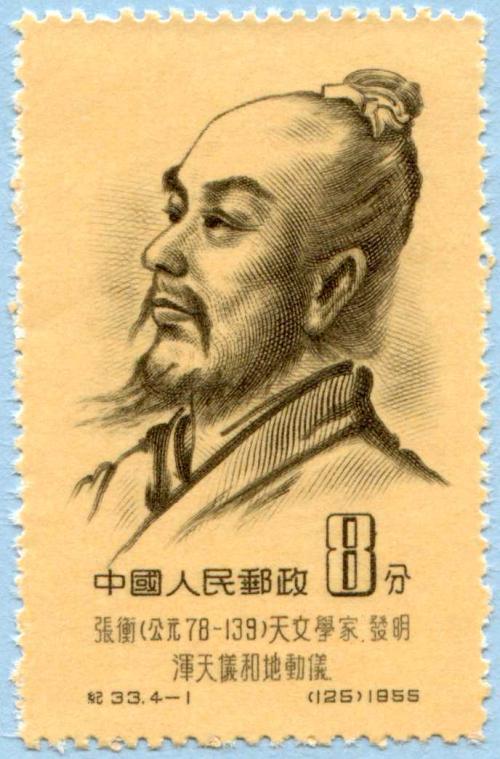
- Early Life
Zhang Heng was born in the year 78 in Nan-yang, China, during the Eastern Han dynasty. This was a time when China was growing stronger and wiser. The Han rulers encouraged learning and wanted clever people to help run the country.
Zhang came from a respected family, so he had the chance to study many subjects. As a young man, he focused on writing and literature. He loved reading books, learning history, and understanding the ideas of Confucious, a wise teacher.
For ten years, Zhang trained to be a writer. His early poems and stories became well-known, showing that he was already a talented thinker. But when he turned 30, something changed, and Zhang became deeply interested in science, especially astronomy.
- Career Highlights
Zhang Heng worked as an official in the royal court in Luoyang. His most important job was as Chief Astronomer, where he watched the stars to help guide the emperor.
One of his greatest inventions was a seismograph, built in 132. This device could detect earthquakes, even ones far away, which was very important as earthquakes were thought to be warnings from the gods about poor leadership. His design was amazing. It had dragon heads holding balls, and when the ground shook, a ball would drop into a frog's mouth, showing the direction of the earthquake.
In one case, it worked even when nobody felt the quake! A messenger arrived at the court not long afterwards to inform people about the event, confirming the invention had worked.
Zhang also created an armillary sphere (an early model of the sky) that used water to make it rotate. It helped map the stars and planets more accurately. He wrote about space, saying the Earth sat like a yolk in the centre of a round egg. Zhang helped correct the Chinese calendar using his star studies.
He also explained how lunar eclipses and solar eclipses occur. He stated that the Sun gives off light while the Moon reflects it, and that the motion of the Sun, Earth, and Moon can block the light at times.
In maths, he studied shapes and tried to estimate pi using square and circle formulas. While his numbers weren't perfect, he was one of the first in China to try using maths theory, not just measurements. He also worked with magic squares, which are number puzzles that are still popular today.
- Legacy
Zhang Heng is remembered as one of ancient China's greatest minds. His seismograph is considered the world's first, and his ideas helped later scientists explore earthquakes. He pushed Chinese astronomy forward by creating tools and writing about the stars in new ways. Even though some of his maths was not exact, his methods showed early signs of deeper thinking in science and theory.
His work inspired others to keep learning and questioning the world. People today still admire Zhang for his mix of creativity, wisdom, and curiosity. In China, his name is linked with brilliance, and he's even been honoured by having a crater on the Moon and an asteroid named after him.
- Other Interests
Before he became a scientist, Zhang Heng was a famous poet and writer. He wrote over twenty pieces, many of which were in a special form of prose poetry. His writing often shared deep ideas about nature, politics, and life.
One of his most famous works, 'Four Stanzas of Sorrow', is the earliest known seven-syllable poem in China. He also wrote 'To Live in Seclusion', showing his wish to live quietly and think deeply. He was a man of both words and wonder.