
Year born: 1938
Research Areas: Geology
"No matter where you come from or what challenges you face, always do the best possible job you can. Run behind your dreams, embrace your heritage, and never stop learning."
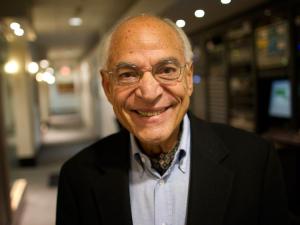
Early Life
Farouk El-Baz was born in 1938 in Zagazig. In school, he liked science. He earned his bachelor's degree in Chemistry-Geology in 1958 in Egypt. In 1961, he got his master's in geology.
After this, in 1964, he got his PhD also in geology. During his PhD, he did research at MIT. When he was a child, he went on a pilgrimage to Mecca, where he touched the Black Stone. This made him come up with the idea of touchable moon rocks at museums.
Career Highlights
Farouk El-Baz is a space scientist and geologist. He played a key role in NASA's Apollo program. He helped to choose the place for Apollo 11 to land in 1969. He supervised the Lunar Science Planning; as part of this, he looked at moon photos and trained astronauts to select samples of moonstones and soil to bring back to Earth to study.
He was also a part of Apollo 15's rover mission in 1971. He often spoke to the press on NASA's lunar missions as he made science easy for people to understand. After Apollo ended in 1972, El-Baz founded the Smithsonian Centre for Earth and Planetary Studies. He named lunar features and led Earth observation experiments for the Apollo-Soyuz mission in 1975. This mission focused on desert landscapes.
Over the past 20 years, El-Baz has used satellite images to study desert landforms. His research showed that deserts formed by natural climate changes, not human activity. By looking at radar images, he found out that there are ancient rivers and streams buried under the Sahara! From 1982 to 1986, he worked in optical systems before he joined Boston University. His works have earned him honours from the Geological Society of America and other places. In 2011, he joined Egypt's Free Egyptians Party.
Legacy
Farouk El-Baz has received many awards, including NASA's Apollo Achievement Award, the Golden Door Award from the International Institute of Boston, and the Nevada Medal from the Desert Research Institute.
The asteroid '7371 El-Baz' was named after him to recognise his work. This was discovered by Eleanor Helin and Schelte Bus in 1978. As well as this, a shuttle named El-Baz was in Star Trek!
Other Interests
He is married and is a loving father to four daughters and six grandchildren. He is also the brother of the late politician Osama El-Baz, who has served as a senior advisor to Egypt's former president.