Year born: Late 1980s
Research Areas: Atmospheric and Oceanic Sciences
"For minority students, and especially women, I want to tell them that it is possible to achieve their goals, and that they should never stop pursuing their dream."
Source: Early Career Scientist Spotlight - Bea Gallardo-Lacourt. Nasa.gov, 2018
Early Life
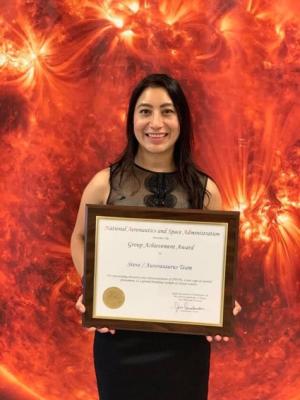
Bea Gallardo-Lacourt was born in Santiago, Chile. She grew up in a busy city and loved science from a young age. She liked to ask questions about how the world worked.
When she was in secondary school, she spent her free time in a physics lab at the University of Santiago. She also went to a physics summer school at the University of Chile. These experiences helped her learn how real science is done.
She studied physics and Engineering at the University of Chile. After that, she completed a master’s degree in physics. Her work focused on applied physics, which means using physics to solve real problems.
In 2010, she moved to Los Angeles to study at UCLA. She began a PhD in space physics. Her PhD looked at how energy moves between space and Earth’s upper atmosphere. This happens near the North and South Poles, where the aurora forms.
Career highlights
After Bea completed her PhD, she moved to Canada. She joined the Auroral Imaging Group at the University of Calgary. Here, she studied a new sky event called STEVE. STEVE is a strange purple light in the sky. It was first seen by amateur skywatchers in a Facebook group. Her research helped scientists understand how STEVE forms.
After two years, she won the NASA Jack Eddy Fellowship. This is a very competitive award. She moved to the NASA Goddard Space Flight Centre in Maryland. Her team used a tool called optical flow. Optical flow is a computer method that follows movement in images. They used it to study how auroral lights move across the sky. When her NASA fellowship ended, she stayed at Goddard as a scientist. She now studies mesoscale structures in space. These are medium-sized features that help move energy and particles between Earth and space.
She also became the Ground-based Coordination Lead for a NASA mission called Geospace Dynamics Constellation (GDC). Her job is to link ground observatories with satellites. She works with teams all over the world.
Bea also supports the science community. Since 2022, she has been the Chair of a National Science Foundation (NSF) research group. This group studies changes in the night sky. She helps run STEVE workshops too. These workshops bring scientists and skywatchers together. She serves on committees that support young scientists and Hispanic physicists. She is also an editor for an AGU space science book series. She helps choose and review new research for these books.
Legacy
Bea Gallardo-Lacourt has made important contributions to space physics. She helped scientists understand STEVE and other auroral processes. Her work is used by researchers around the world.
She has received many awards. In 2024, she won the NASA Robert H. Goddard Award for Exceptional Achievement in Leadership. This is one of NASA’s top honours.
Her work inspires students, researchers, and skywatchers. She shows that science is stronger when many people share their ideas.
Other interests
Bea enjoys learning languages. She studied French while growing up in Chile. She learned English after moving to the United States. She has also taken classes in Russian and Italian.
She enjoys sewing and hopes to learn how to make quilts. She also enjoys books, music, and exploring new hobbies in her free time.