
Year born: 1936
Research Areas: High Energy Physics
"Without fundamental science, the world cannot move forward"
Source: Translated from Sciences et Avenir.
Early Life
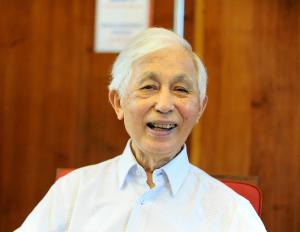
Trần Thanh Vân was born in 1936 in Quảng Bình, Vietnam. He went to high school in the royal city of Huế. In 1953, he moved to France to study Mathematics and Physics at the Université de Paris. He completed his PhD there in 1963. His research focused on the neutron. A neutron is a small particle inside atoms.
Career highlights
After his PhD, Trần Thanh Vân joined the French National Centre for Scientific Research (CNRS). He spent his full research career there. Over time, he moved into senior roles. In 1991, he became a Research Director. This is the highest research rank at CNRS.
Trần is best known for organising international science meetings. He believed science should cross borders. He also believed young scientists should be part of key discussions. In 1966, he founded the Rencontres de Moriond conference series. In 1989, he started the Rencontres de Bloismeetings. These conferences brought scientists together from many countries. They helped people share ideas and results.
The Moriond meetings were unusual at the time. They were the first major physics meetings held in winter. Over the years, they became yearly events. Today, they are important in high-energy physics.
In 1993, Vietnam reopened its borders to foreign scientists. Trần Thanh Vân quickly organised the Rencontres du Vietnam meetings. These events helped Vietnamese scientists reconnect with the world. They also helped science grow in Vietnam.
Legacy
Trần Thanh Vân’s work received wide recognition. In 1999, France named him a Knight of the Legion of Honour. This is the country’s highest national award.
In 2011, he received the Tate Medal for International Leadership in Physics from the American Institute of Physics.
In 2015, Vietnam awarded him the Friendship Order. This honoured his long support for Vietnamese science.
Much of his legacy is shared with his wife, Lê Kim Ngọc. Together, they helped create Children SOS Village. This charity supports poor families and children in Vietnam. They also helped found the Odon Vallet Scholarship. This programme supports thousands of students each year. It supports students from high school to university.
They also helped establish the International Center of Interdisciplinary Science Education (ICISE) in Quy Nhơn City. ICISE is now the largest scientific conference centre in Vietnam. Scientists from many countries continue to meet and work there.