
Year born: 1946
Research Areas: Brown Dwarfs, Exoplanets
"a dark, moonless night, in which the stars looked spectacular from the mountain, on Cerro Tololo; I realised what I wanted to do for the rest of my life...investigate the Universe."
Source: “María Teresa Ruiz, Chilean Astronomer.” Salient Women, 18 May 2020

Early Life
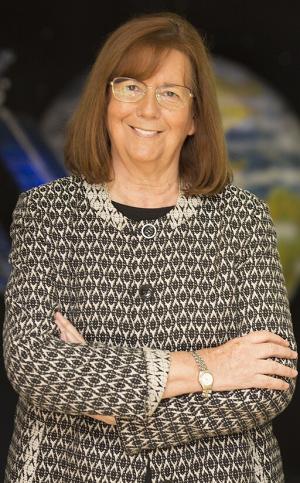
Maria was born in Santiago, Chile, in 1946. She fell in love with astronomy after attending a summer school about it. She went on to study astronomy in Chile and was the first person to graduate from this program in 1971. Ruiz earned her PhD in Astrophysics in 1975 and became the first woman to earn a PhD from Princeton.
Career highlights
Maria held a research post at the Trieste Observatory between 1975 and 1976 while doing her PhD. She also worked for two years at the Institute of Astronomy at UNAM in Mexico.
Maria then returned to Chile and taught at the Department of Astronomy at the Universidad de Chile. She was first an associate and then a full professor.
She found it hard to be an astronomer and a mother, and had many financial constraints. Despite this, she had access to one of the largest telescopes in the Southern Hemisphere. She decided to work on something that no one else was: the smallest stars that are closest to the Sun.
In 1997, Maria discovered Kelu-1. This is a structure of two brown dwarfs and one of the first systems of free-floating brown dwarfs. The system is only 61 light-years away from Earth. She saw that there was lithium in the star and also noticed that it was very red. These two things helped her confirm that the structure was a brown dwarf. The image that she got was made through an infrared filter with the 3.6-metre telescope at the La Silla Observatory. The discovery encouraged her to pursue a new line of research on brown dwarfs.
The same year, Maria became the first woman in Chile's history to get the country's National Prize for Exact Sciences. In particular, for her studies of low-mass dwarf stars, the discovery of a supernova in the act of exploding, the discovery of two planetary nebulae in our galaxy's halo, and the discovery of a brown dwarf (or super-planet) near the Solar System!
Since 1997, she has worked more on planets outside of our Solar System, as brown dwarfs can tell us a lot about these exoplanets.
Legacy
The discovery of Kelu-1 made a big mark on astronomy. It showed that stars could form much earlier in the Universe than was first thought. She has won many awards for contributions to science. Maria has even written books called 'Children of the Stars' and 'From Chile to a starry sky: readings to become fascinated with astronomy' to inspire others to look at the sky.
Other interests
Maria's hobby is embroidery. It started when she made a family portrait to take with her when she studied abroad to keep her family close. She has even exhibited her textile work at science festivals.