
Short Intro Text
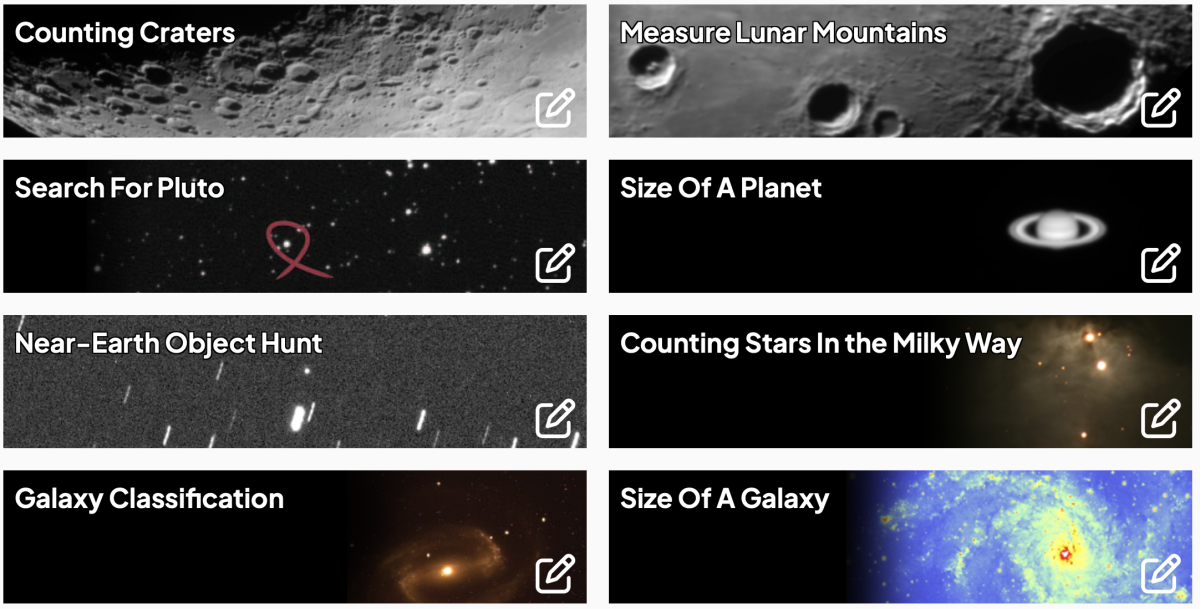
These investigations use real data from our robotic telescopes. They are taken from our Things To Do section and collected here to help you find activities linked to Go Observing.
Your students can request their own images and use them to explore space like real astronomers.
These activities support:
- Working scientifically
- Enquiry skills
- Understanding evidence
- Key space and physics concepts
Image
Credit
This work
by The Schools' Observatory
is licensed under All rights reserved
Many of these activities also link directly to GCSE Astronomy observational tasks. Below, you will find a selection of classroom investigations that use telescope images.
Activity | Description |
|---|---|
| Explore Messier Objects | Your students will request images of famous deep-sky objects in the Messier Catalogue. They compare star clusters, nebulae, and galaxies. This helps them learn how objects are organised in space. |
| Find the Moon Missions | Using telescope images, students locate landing sites from Moon missions, including Apollo. They also explore features such as craters and lunar Seas. |
| Investigate the Milky Way | Students take images in different parts of the sky. They count stars in each image and compare bright and dark areas. This helps them understand what our galaxy looks like from Earth. |
| Investigate the Size of a Galaxy | Students measure the width of a galaxy from its image. They then use distance data to estimate its true size. This supports learning about scale and light years. |
| Investigate the Size of a Planet | Students observe planets on different dates. They see how the apparent size changes as Earth and the planet move. This builds understanding of orbits and distance. |
| Keep Watch on Asteroids | Students take images of an asteroid over several nights. By tracking its movement against the stars, they learn how scientists monitor objects in our Solar System. |
| The Changing Moon | Students collect images of the Moon over a month. They record how the shape and position change. This explains why phases repeat in a regular cycle. |