The Schools' Observatory News
April 2026

Global Astronomy Month: Join the Celebration!
April marks Global Astronomy Month, the world’s largest celebration of astronomy and a perfect opportunity to bring the wonders of the Universe into your classroom after the Easter break.
This annual event encourages people of all ages to look up, explore the night sky, and take part in astronomy activities. Whether you’re new to astronomy or already exploring space with your students, it’s a great time to get involved.
At The Schools’ Observatory, we have everything you need to take part:
- Go Observing - Request your own real observations using professional telescopes and explore objects in space with your students.
- AstroLab - Analyse real telescope data and create your own images, including our new 3-colour imaging feature!
- Things To Do - A wide range of classroom-ready activities covering topics from planets and stars to galaxies and space exploration.
- Learn - Our online astronomy textbook has been carefully developed by experts to give you a broad and accessible understanding of space topics.
- Career Heroes - Inspire your students with real stories of scientists and engineers from diverse backgrounds working in space and STEM.
Global Astronomy Month is all about curiosity, discovery, and sharing the excitement of space. Let’s celebrate the Universe together and happy exploring!

International Day of Human Space Flight
Every year on 12th April, we celebrate the International Day of Human Space Flight, marking the moment in 1961 when Yuri Gagarin became the first human to travel into space. His historic journey opened the door to decades of exploration, innovation, and discovery.
This day is a chance to reflect on how far we have come and to spark conversations about where we might go next.
Why not explore past missions and the future of space travel with your students?
- Let’s Explore Astronauts – What is life like for astronauts, and what skills do they need?
- Host a Space Debate – Get your class discussing big ideas like space tourism and human settlements on other planets.
- Read All About It – Man on the Moon – Explore how the Moon landing was shared with the world through newspapers.
- Timeline of Apollo Missions – Follow the major milestones of human space exploration.
Celebrate the spirit of discovery that launched us into space and inspire your students to imagine what the next giant leap might be.
World Art Day: Celebrate Space Through Creativity!
15th April marks World Art Day, a celebration of creativity and expression. It is also a great opportunity to explore how art and astronomy can come together, whether through drawing galaxies, sculpting planets, or imagining new worlds.
Why not try one of our art-inspired activities?
- Colour Your Space – Use your imagination to colour stunning images from space and make them your own.
- Design a Planet – Create your own world, decide its size, temperature, number of moons, and even invent the life forms that could live there.
- Make a Play-doh Solar System – Get hands-on with this creative task and bring our Solar System to life with modelling dough.
- Artistic Inspiration with Blue Room - You can also get inspired by taking a look at the Blue Room project, where learning disabled and neurodivergent artists explored space using real telescope data and created artwork inspired by their observations.
From visual storytelling to scientific sketching, astronomy has long inspired artists. Let your students celebrate the universe with curiosity and creativity this World Art Day!
Earth Day: Protecting Our Planet!
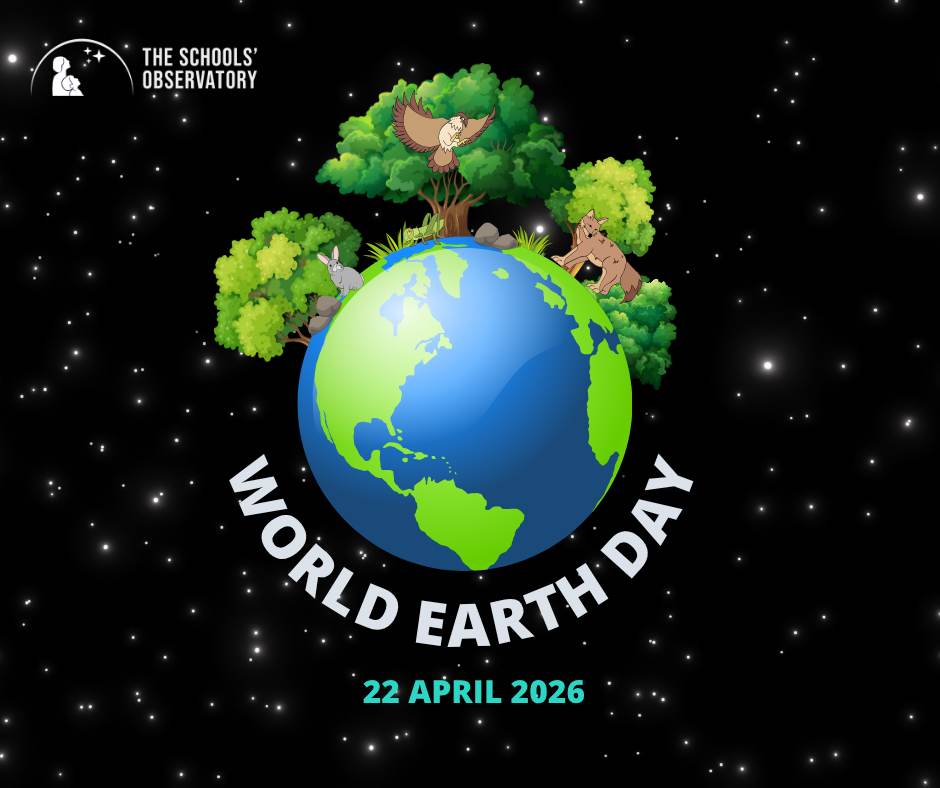
22nd April is Earth Day, a global reminder of the need to care for our planet. It is also a chance to reflect on how protecting Earth helps us better explore and understand the universe.
From reducing light pollution to promoting sustainable living, small actions can make a big difference. Dark skies not only benefit wildlife and ecosystems, but they also allow us to see more of the stars.
Explore these activities with your students to think about Earth’s unique place in the cosmos:
- What Does Life Need? – Discover what makes Earth the perfect home for life and whether other planets could support it.
- Hot, Cold, or Just Right – Investigate how a planet’s distance from its star affects its ability to support life.
- Life on Earth – Learn how different environments on Earth support different life forms, and what that tells us about the search for life elsewhere.
This Earth Day, celebrate the delicate balance that makes life on our planet possible and think about how we can protect it for future generations of skywatchers.
Work Experience Week: Applications Are Closing Soon!
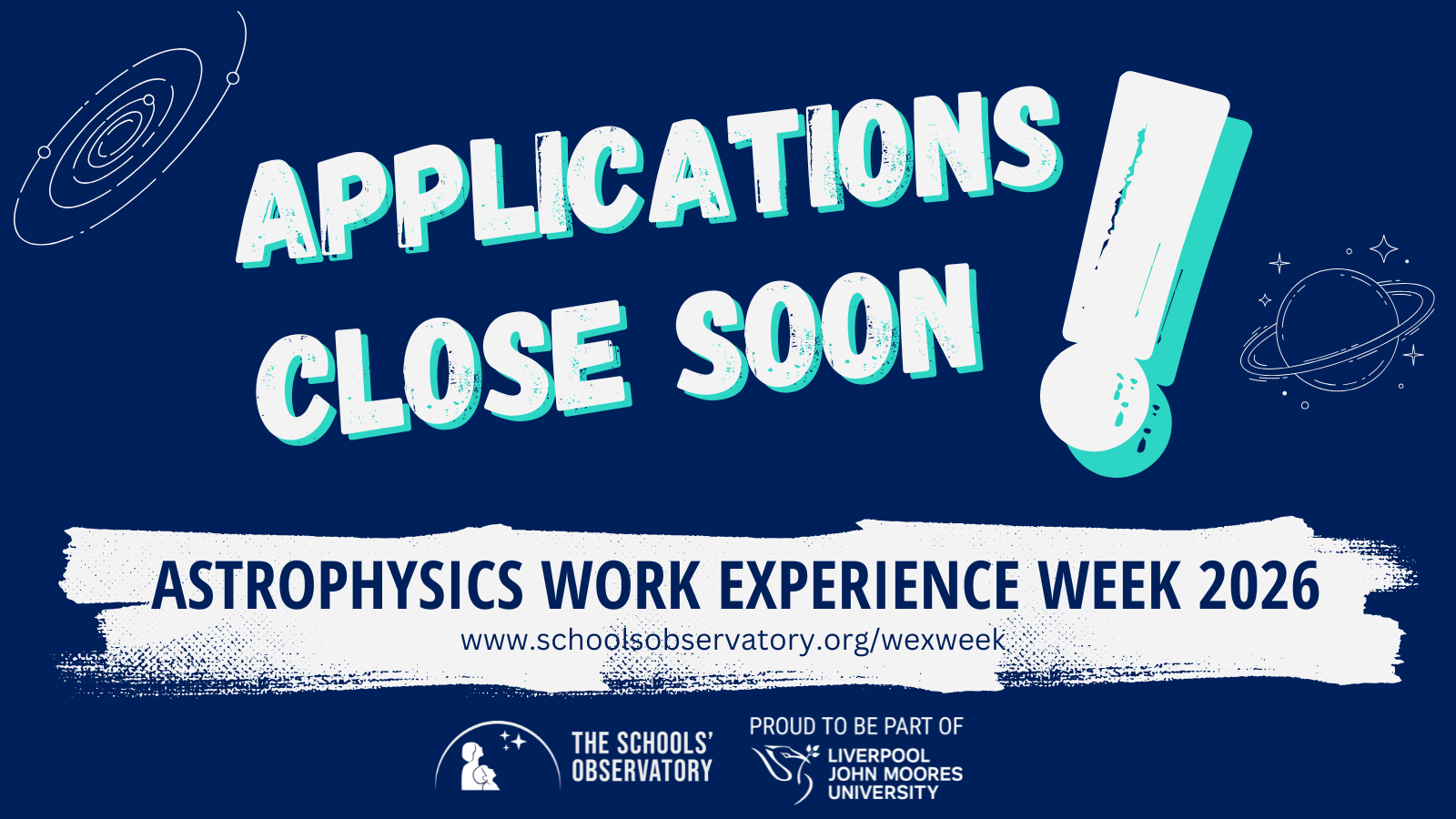
Applications for our annual non-residential Work Experience Week are closing soon on 13th April (midnight). This opportunity is for students in Year 12 (or equivalent) in the UK and Ireland. Please share this opportunity with your students and your wider network.
This programme gives students a real insight into how professional research is carried out at a university. Throughout the week, students will take part in talks and hands-on workshops, then work in pairs to research an area of astrophysics and create a poster to present their work.
We especially encourage applications from students in the Liverpool City Region.
What students will explore:
- Introduction to Astrophysics Using Astronomical Data
- Introduction to Robotic Telescopes
- Design a Telescope
- Science Communication Skills
- University Life
- Careers in Physics
Students will also have the chance to chat with current university students and ask questions about studying at university.
For full details, eligibility criteria, and the application form, please visit our Work Experience page.
Help Us Grow: Join Our Online Focus Groups!
We’re always looking for ways to make The Schools’ Observatory better for you and your students and we’d love your help.
The Schools’ Observatory is free to use, thanks to generous funding from Liverpool John Moores University (LJMU). Our telescope time is also kindly supported by LJMU (via the Liverpool Telescope) and the Dill Faulkes Educational Trust (via the Las Cumbres Observatory Network).
Our mission is simple: to provide free, high-quality resources that inspire young people to think about STEM careers and support educators in teaching STEM subjects. To do this well, we need to understand the impact we’re having.
That’s why we’re inviting educators and users to take part in online focus groups, led by the LJMU School of Education, who are helping us evaluate and improve the service.
If you’d like to share your thoughts, experiences, and ideas, we’d really appreciate your time. Register your interest by filling in this form.
Your feedback helps shape what we do next and thank you for being part of our journey!
Look to the Sky!
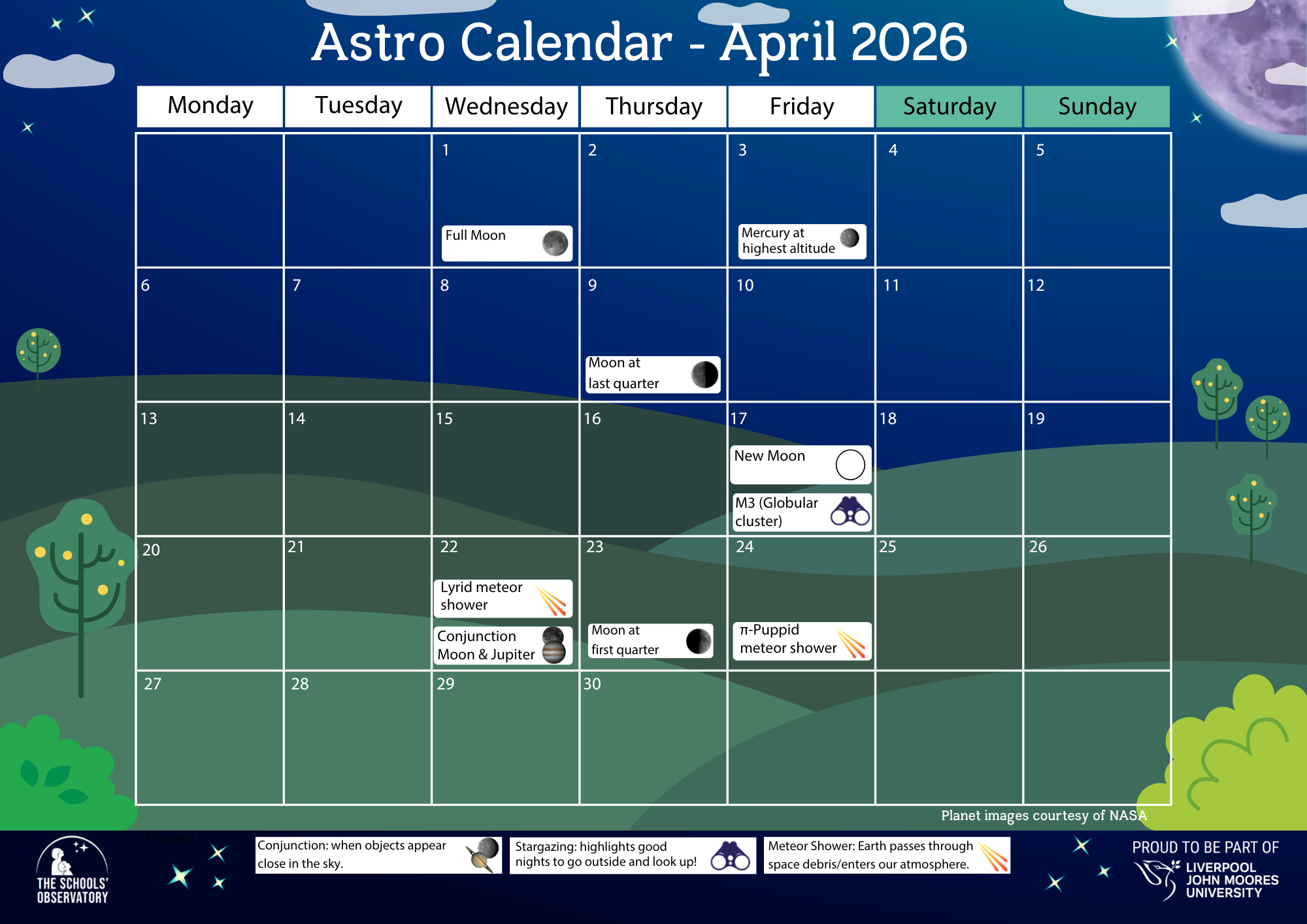
Plan your stargazing adventures with our April astronomy calendar! Download it to display at home or in the classroom. Get ready for an exciting month of celestial events, including the Lyrid Meteor Shower, Mercury at its highest altitude and conjunctions between the Moon and some of the Solar System’s most impressive planets. Don’t miss out on what the night sky has to offer!
Download and display April's astronomy calendar!