
The Schools' Observatory News
July 2026

World Population Day!
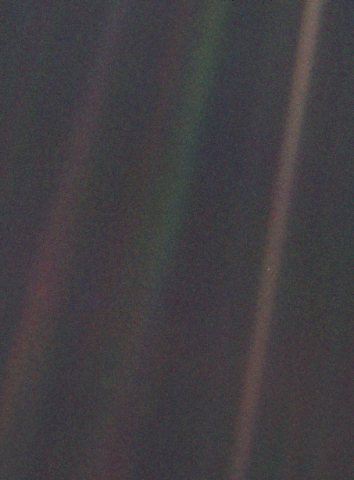
World Population Day, celebrated on 11th July, is a great chance to reflect on the people who share our remarkable planet. From space, Earth looks very different. In 1990, NASA's Voyager 1 spacecraft turned its camera back towards home and captured a tiny image of Earth from over 6 billion kilometres away. The photograph became known as the Pale Blue Dot, a powerful reminder that every person, every community, and every living thing we know exists on this small blue world.
It's a wonderful opportunity to encourage students to think about what makes Earth so special, and why, despite discovering thousands of planets beyond our Solar System, it remains the only place known to support life.
Why not explore these activities with your learners?
- Life on Earth – Discover what makes our planet unique.
- What Does Life Need? – Explore the ingredients needed for life and consider whether they might exist elsewhere in the Universe.
- Hot, Cold, or Just Right? – Compare Earth with other planets and investigate what makes a world habitable.
From our tiny place in the cosmos, we are reminded that looking after our planet is just as important as exploring the Universe beyond it.
World Youth Skills Day!
15th July marks World Youth Skills Day, celebrating the knowledge and skills that help young people prepare for the future. At The Schools' Observatory, we believe that learning about space is about much more than astronomy.
Our activities help students develop valuable skills that can be applied across science, technology, engineering, and mathematics (STEM), and beyond. Whether they're analysing real telescope data, solving problems, interpreting graphs, or communicating scientific ideas, students are building the confidence and transferable skills needed for tomorrow's careers.
Inspire your students to think about their futures with these engaging activities:
- Space Job Game – Encourage pupils to assess their skills and qualities and discover which job roles suit them best.
- Space for Everyone Quiz – Use this quiz to spark class discussions on inequalities and challenge stereotypes about those working in the STEM fields.
- Skills for Space video – Use this video, and accompanying quiz, to teach pupils about the necessary skills for a career in the space industry. Each quiz question is linked to one of our Career heroes - diverse, significant figures from the realms of space, science, and technology who serve as inspirational role models.
Apollo 11 Moon Landing Anniversary!
Few moments in space history are as powerful as the first Moon landing. On 20th July, we celebrate the anniversary of Apollo 11, the mission that saw humans walk on the surface of another world for the very first time.
This historic achievement continues to inspire curiosity, ambition, and big questions about space exploration. Why not use the anniversary to explore the science, stories, and legacy of the Moon landings with your learners?
Try these Things To Do activities:
- Timeline of Apollo Missions – Follow the journey from Apollo 11 to Apollo 17 and see how astronauts reached the Moon.
- Read All About It – Man on the Moon! – Explore a newspaper-style article about the first Moon landing and its global impact.
- Find the Moon Missions – Use images taken with the Liverpool Telescope to see where astronauts explored on the Moon.
- The First Moon Landing – Test your knowledge about Apollo 11 with this short interactive quiz!
It’s a great way to celebrate one of humanity’s most famous space achievements and inspire the next generation of explorers.
Love Nature: From Parks to Planets!
Late July is a lovely time to celebrate the world around us, with Love Parks Week (24th July - 2nd August) and World Nature Conservation Day (28th July) both encouraging us to appreciate and protect our natural spaces.
Whether you're visiting a local park, enjoying some fresh air, or simply noticing the wildlife around you, it's a great reminder that Earth is a very special place. And if you'd like to add a space twist to your walk, why not try Walking the Solar System while you're there? You can also explore these outdoor-inspired activities:
- Make a Sundial – Use the Sun to tell the time and learn how people measured the passing of the day long before clocks.
- Investigate How the Sun Supports Life – Explore how sunlight helps plants make food and produce oxygen.
- Why Do Shadows Change Over Time? – Investigate how the Sun's position in the sky affects the length and direction of shadows throughout the day.
- Explore Day and Night Around the World – Discover how Earth's rotation creates day and night and why different places experience daylight differently.
Get outside, look up, and enjoy exploring the connections between our planet, the Sun, and the wider Universe this summer!
Look to the Sky!
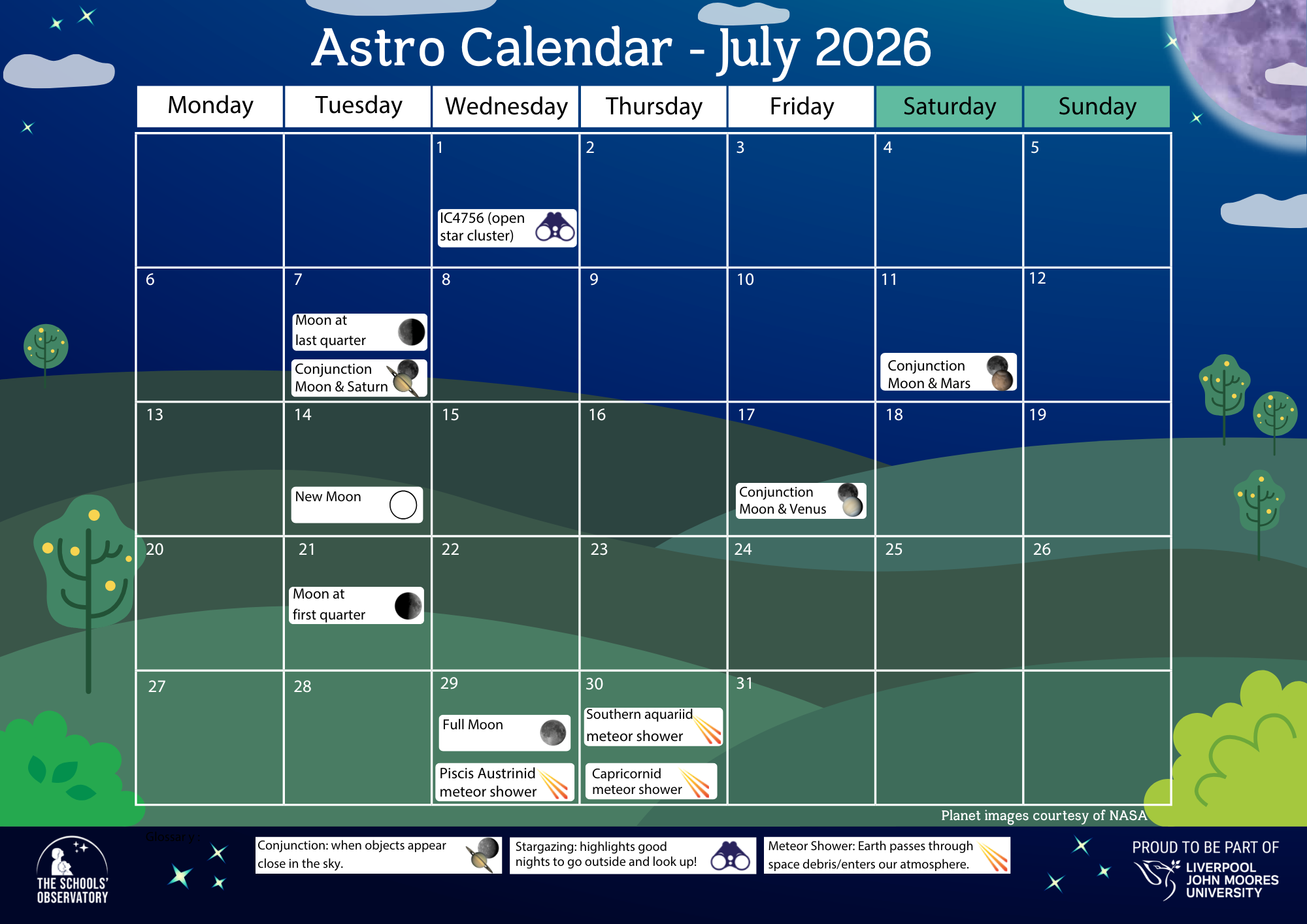
Plan your stargazing adventures with our July astronomy calendar! Download it to display at home or in the classroom. Get ready for an exciting month of celestial events, including Meteor showers and conjunctions between the Moon and some of the Solar System’s most impressive planets. Don’t miss out on what the night sky has to offer!
Download and display July's astronomy calendar!
Enjoy your Summer Break!
As the school year draws to a close, we’d like to wish all our educators, students, and supporters a joyful and restful summer break. Whether you’re travelling, relaxing, exploring, or looking up at the night sky, we hope your summer is full of curiosity, discovery, and well-earned rest.