The Schools' Observatory News
February 2026

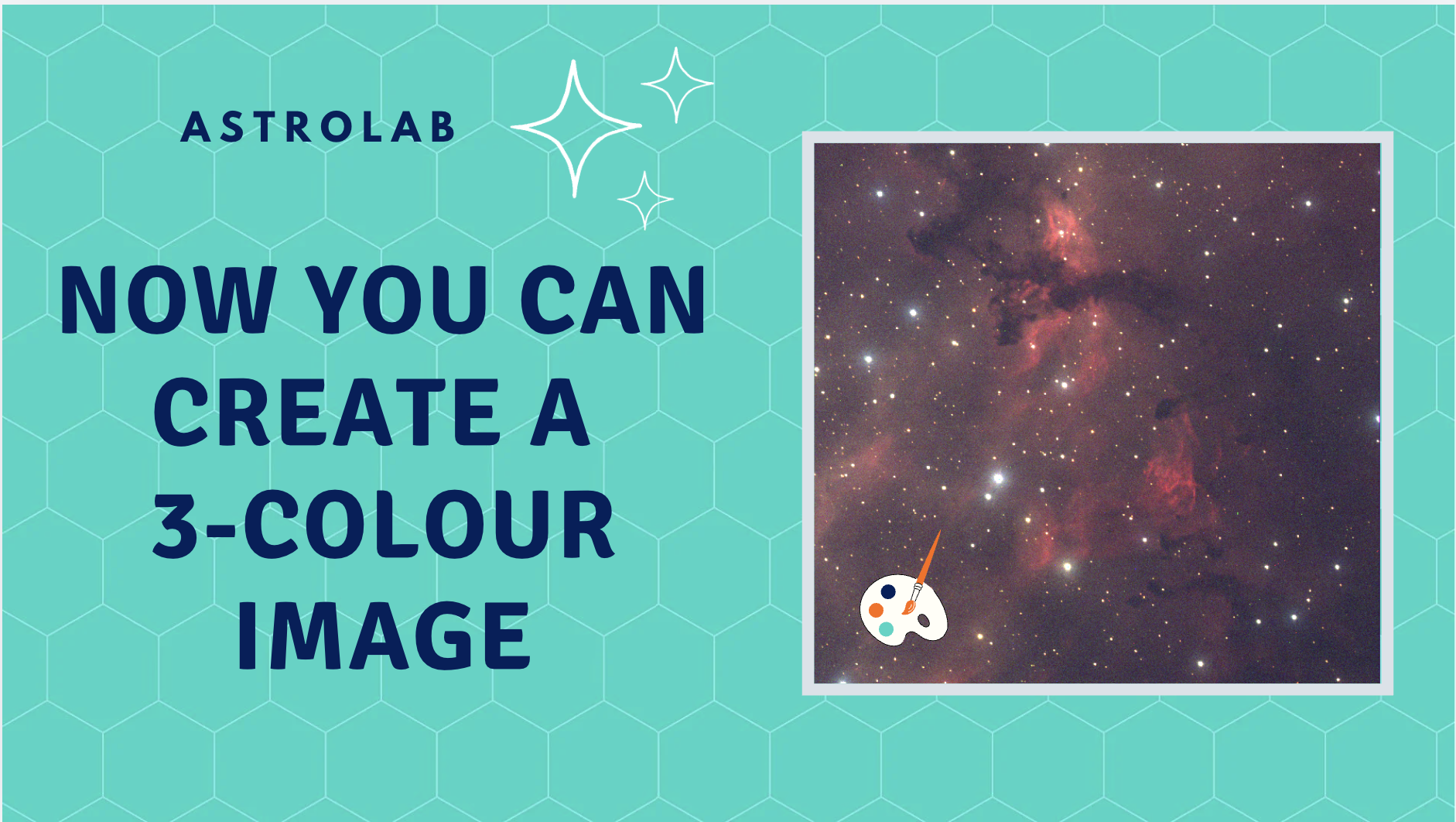
AstroLab Update: Create Stunning 3-Colour Images!
We’re excited to introduce a new creative feature in AstroLab, 3-colour imaging!
AstroLab helps you explore telescope images in different ways, and now you can go one step further by creating colourful astronomical images, just like real astronomers do.
So why are telescope images usually black and white? Astronomy cameras don’t see colour like our eyes do. They only measure brightness. To capture colour, astronomers use filters placed in front of the camera. For example, a B filter measures how bright an object is in blue light. By taking images through different filters and merging them together, we can create 3-colour images.
We usually use red, green, and blue because they best match how our eyes see the Universe. You can now learn how to do this yourself using AstroLab!
Follow our step-by-step guide here. We can’t wait to see what you create. Happy, colourful exploring!
If you’d like to share your images, send them to us at SchoolsObs@ljmu.ac.uk, we’d love to see your beautiful creations!
For Schools in Liverpool City Region: Bring STEM Investigations to Your Classroom!
We’re inviting Year 5 classes to take part in Can We Get Humans to Mars?, a brand-new, free STEM programme funded by Liverpool John Moores University and The Royal Society.
The project is designed to spark curiosity, build scientific skills, and give students a taste of real space exploration. It also supports the Earth and Space topic in the national curriculum.
What your school will receive:
- A trained, passionate STEM ambassador to work directly with your students
- 4 in-person visits to your school across one term
- 6 hands-on, cross-curricular investigations themed around getting humans to Mars
- Resources and support for 3 teacher-led sessions
- 2 CPD events for your lead teacher, hosted at Liverpool John Moores University
- Cover costs for staff attending the CPD
- A student engagement programme that builds problem-solving and scientific thinking
Completion rewards include:
- A set of space-themed library books
- 2 Arduino robots for your school
We’re now coming to the end of Phase 1, and we are recruiting 14 schools for Phase 2.
Key dates:
- CPD: March/April 2026
- In-school delivery: April–July 2026
Places are limited so if your school is interested, please register using this form.
Work Experience Applications Opening Soon!
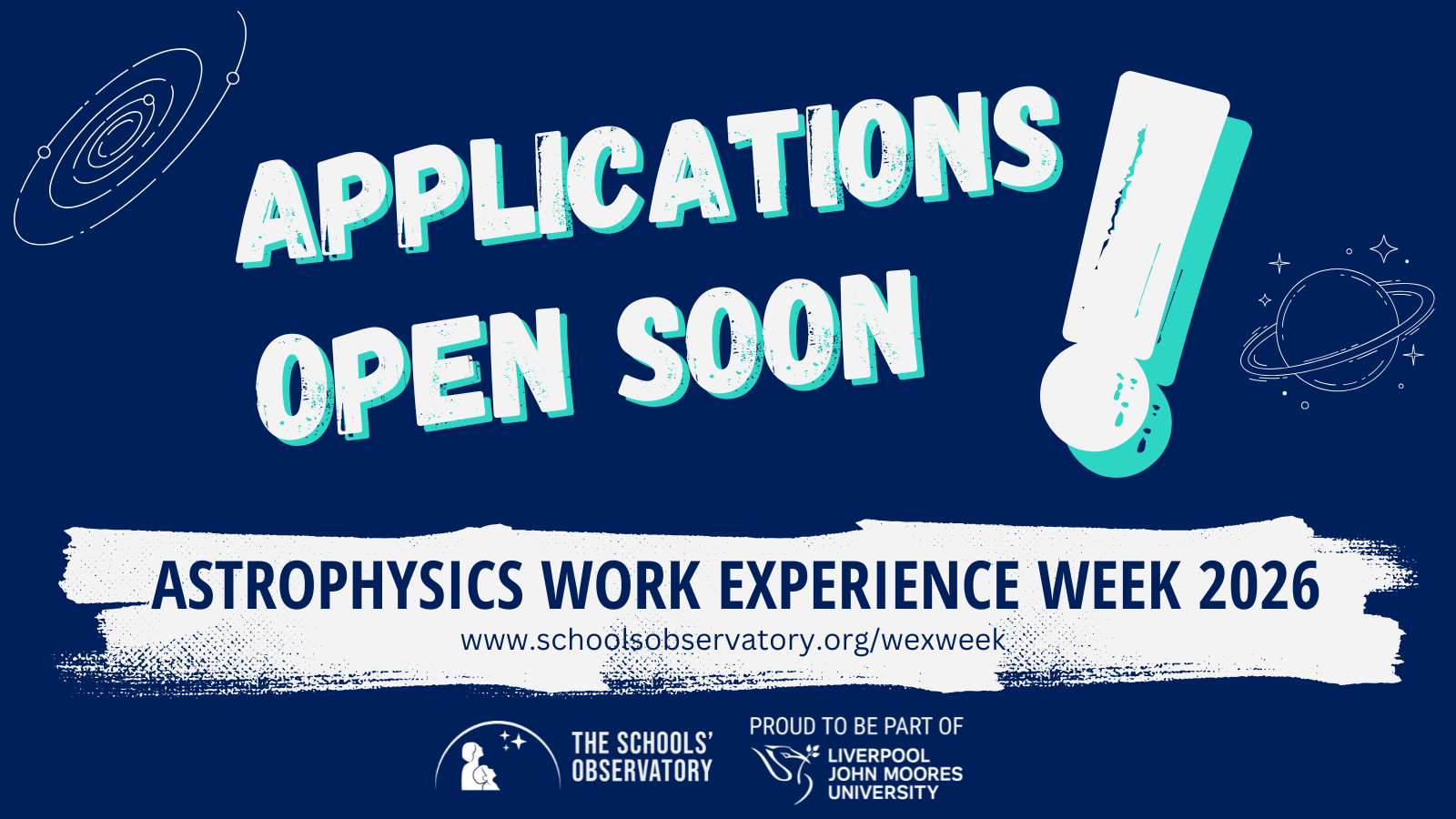
Applications for our annual non-residential Work Experience Week will open on 2nd February for students in Year 12 (or equivalent) in the UK and Ireland. Please share this opportunity with your students and your wider network.
This programme gives students a real insight into how professional research is carried out at a university. Throughout the week, students will take part in talks and hands-on workshops, then work in pairs to research an area of astrophysics and create a poster to present their work.
We especially encourage applications from students in the Liverpool City Region.
What students will explore:
- Introduction to Astrophysics Using Astronomical Data
- Introduction to Robotic Telescopes
- Design a Telescope
- Science Communication Skills
- University Life
- Careers in Physics
Students will also have the chance to chat with current university students and ask questions about studying at university.
For full details, eligibility criteria, and the application form, please visit our Work Experience page.
Help Us Grow: Join Our Online Focus Groups!
We’re always looking for ways to make The Schools’ Observatory better for you and your students and we’d love your help.
The Schools’ Observatory is free to use, thanks to generous funding from Liverpool John Moores University (LJMU). Our telescope time is also kindly supported by LJMU (via the Liverpool Telescope) and the Dill Faulkes Educational Trust (via the Las Cumbres Observatory Network).
Our mission is simple: to provide free, high-quality resources that inspire young people to think about STEM careers and support educators in teaching STEM subjects. To do this well, we need to understand the impact we’re having.
That’s why we’re inviting educators and users to take part in online focus groups, led by the LJMU School of Education, who are helping us evaluate and improve the service.
If you’d like to share your thoughts, experiences, and ideas, we’d really appreciate your time. Register your interest by filling in this form.
Your feedback helps shape what we do next and thank you for being part of our journey!
Get Inspired Section for Educators!
We've launched a brand-new section just for educators: Get Inspired. This is your go-to space for real stories, creative ideas, and practical support.
In this new section, you’ll find:
- Stories from Schools: Creative ways teachers have used our resources and telescopes
- Memorable Projects: Highlights from projects and outreach we’ve been part of
- Grants and Opportunities: If you are an educator in the UK or Ireland, you can find in this section some of the support you can get to kickstart your own ideas
Whether you're after fresh classroom inspiration or thinking of starting your own project, this space is built to celebrate educators like you.
If you’ve used our resources in your classroom, we’d love to hear from you! Share your story by filling in this form and sending it, along with any photos or media, to SchoolsObs@ljmu.ac.uk.
Look to the Sky!
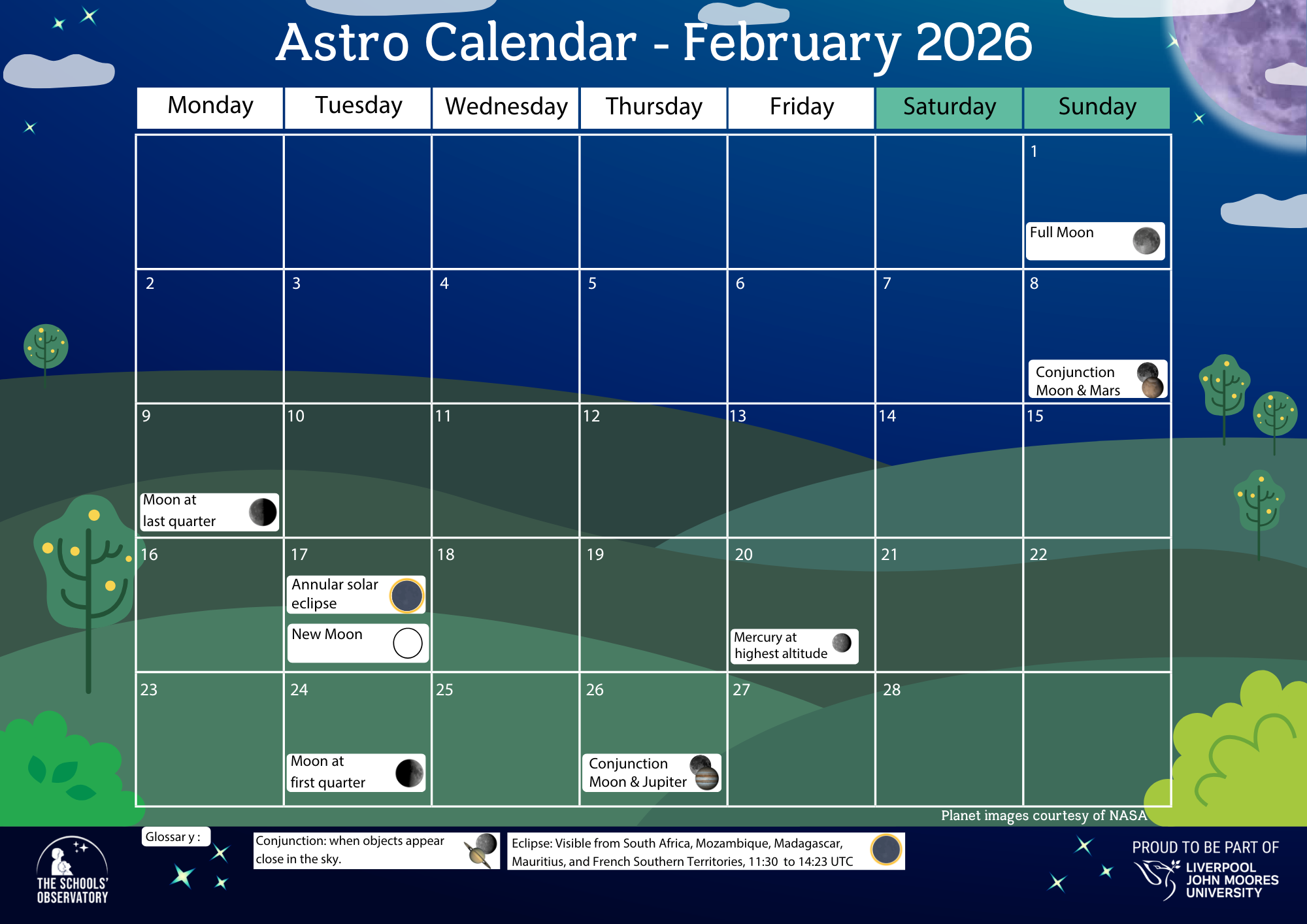
Plan your stargazing adventures with our February astronomy calendar! Download it to display at home or in the classroom. Get ready for an exciting month of celestial events, including conjunctions between the Moon and some of the Solar System’s most impressive planets. Don’t miss out on what the night sky has to offer!
Download and display February's astronomy calendar!