
For a number of years around the Summer Solstice, the Schools' Observatory ran a national experiment to use shadow sticks to measure the size of the Earth.
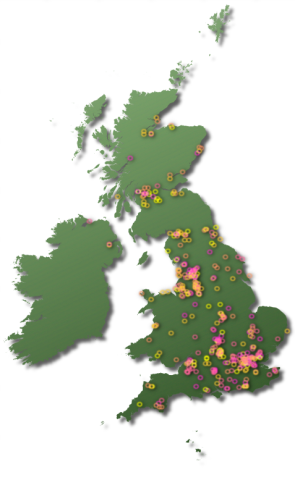
Simple measurements were collected from people all over the UK. Using them we were able to get a good estimate of the circumference of the Earth using a method similar to that of Eratosthenes in around 240 B.C.
A collaboration with the Royal Astronomical Society, the Solstick project was started during the Covid-19 Pandemic in 2020 as a way for people to collaborate from the safety of their own homes with only minimal equipment.
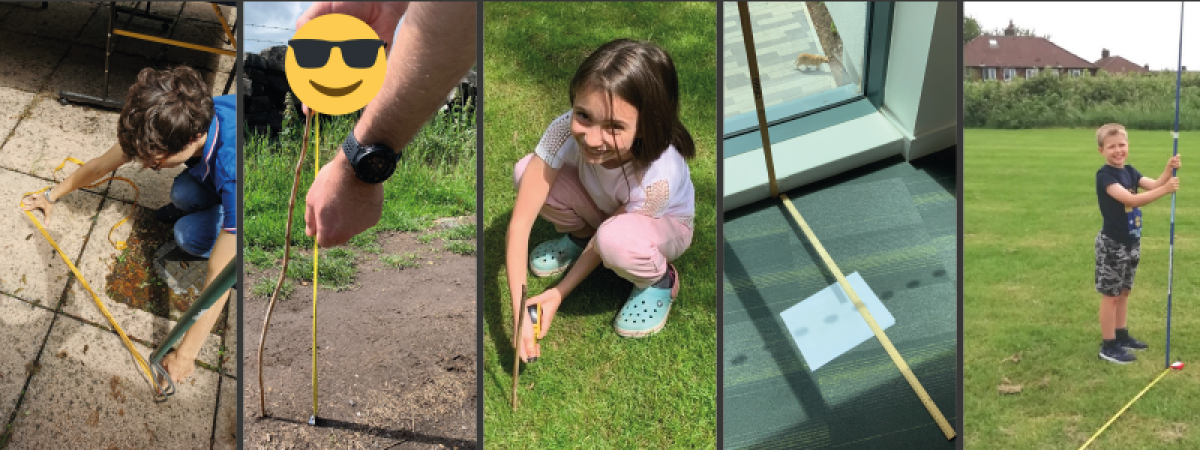
Back in the days before we had satellites and specialist instruments to help us calculate the size of Earth, early scientists found clever ways to calculate the approximate size of the planet. More than 2000 years ago, Eratosthenes realised that he could use the length of shadows to work out an estimated size. By taking two simple measurements at midday on the summer solstice he was able to calculate an accurate estimate of the size of Earth.
For a few days around summer Solstices between 2020 and 2023 people all over the UK took a stick outside at 1PM and carefully measured the length of the shadow it cast.
Thank you to everyone who took part. We had enough measurements submitted to be able to get some good estimates of the size of the Earth, and even use the measurements together to do some even more interesting science.
Averages are better
Each individual measurement gives us a pretty good idea of the size of the Earth - for example, one example measurement from Liverpool gave a circumference of 41,200 km, pretty close to the known value of 40,000km. The reason it is not exactly right is because of unavoidable "errors". Maybe the ground was not exactly flat, or the shadow was bit too fuzzy to see exactly where the end was and so on. However, if one result is a bit too small, somebody else might have an answer that is a bit too large. So, if we get lots of results and average them, all the errors will start to cancel out, and the final value will be much better than any single answer could be.
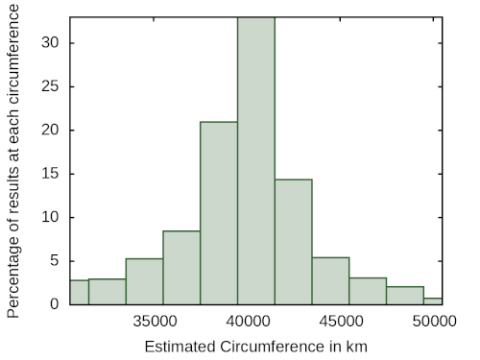
You can see this in the graph. This shows all the best results grouped together and turned into a histogram - a graph which shows how many results we had of each different value. From the width of the histogram, we know that typically the error in each measurement was about 5000km - so anyone who got anywhere between about 35,000km and 45,000km did pretty well.
However, the peak in the middle of the histogram is where the average is - 40,600 km - and because lots of results have gone together to find this value the "error" is smaller - less than 1000km.
Two Stick Results
As you will see from the detailed example, to estimate the circumference of the Earth from a single shadow stick means we need some extra information. In fact, we need to know the distance from where your stick was to the Tropic of Cancer (an imaginary line which runs round the world a bit north of the Equator). To work that out, we need a map showing quite a lot of the Earth, which is actually quite hard to make without already knowing the size of the Earth, so this is perhaps a bit of a cheat!
However, because people got quite a few results for us, we can miss out that step by using pairs of shadows sticks like in the picture here:
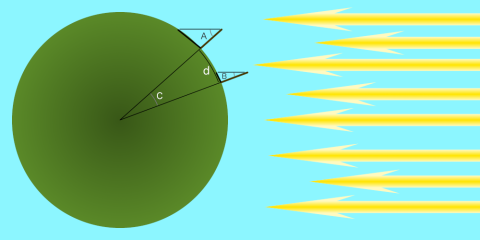
So, by using each pair of results, we can get an estimate of the size of the Earth without knowing the distance to the Tropic of Cancer - we just need to know how far apart the sticks were. We can do this using a much smaller map just of the UK.
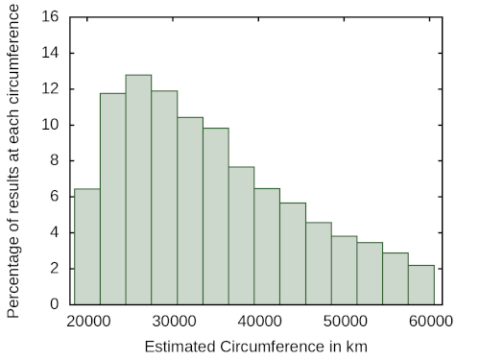
Unfortunately, each individual measurement is going to be less accurate than our first estimates as the sticks are not really very far apart and the "errors" from both will have an effect. But if we take lots of pairs of sticks we can again find the average of all the results.
As you can see from this histogram, the results cover a much larger range, so the average is not quite as good: a circumference of 34,000km. Still, that is not bad at all - well done to everyone who took part!