The Schools’ Observatory is always looking for new ways to connect people with science. One exciting way we did this was through garden shows. We worked with designers, artists, and scientists to build living gardens that joined astronomy and nature.
With support from the Royal Horticultural Society (RHS), we took part in two flower shows. These award-winning gardens helped visitors explore ideas like galaxies and dark matter using plants, shapes, and designs inspired by space.
- Project 1: Watch This Space – RHS Tatton Flower Show (2013)
- Image
 CreditThis work by The Schools' Observatory is licensed under All rights reserved
Project Goal:
To link astronomy and gardening through a galaxy-themed garden.
Duration:
4 months of preparation.
Showcased 25–28 July 2013.
Target audience:
Visitors to the RHS Tatton Flower Show, including families and gardeners.
Funders and partners:
The Schools’ Observatory at LJMU Astrophysics Research Institute, The Institute of Physics, RHS Landstruction, Dori & Howard Miller (Design & Horticulture), Judy Greaves (Sculptor), Dovecote Nurseries, Playtop, Beers, Green-tech.
Project Summary:
In 2013, The Schools’ Observatory joined the RHS Tatton Flower Show for the first time. The theme that year was Galaxy, a great chance to bring astronomy to a new audience.
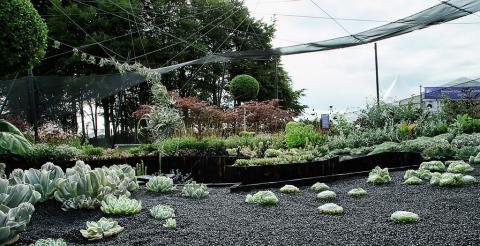
We worked with Howard and Dori Miller, Landstruction, and sculptor Judy Greaves to design a garden showing a giant gas cloud being pulled into a black hole, an event predicted to happen in our own galaxy that year.
We called the garden 'Watch This Space'. It featured spiral arms, bright stars, and a twisting Mobius strip. The design helped visitors imagine the beauty and movement of space.
Have a look at some photographs of the garden on Flickr.
Impact:
- Visited by thousands over 4 days
- Joined scientists and artists in a shared project
- Showed that science can be creative and open to everyone
Highlights:
- Gold Medal & Most Creative Galaxy Garden Award
- Featured on BBC Radio Lancashire and Granada Reports
- Positive coverage in Chester Chronicle!
Image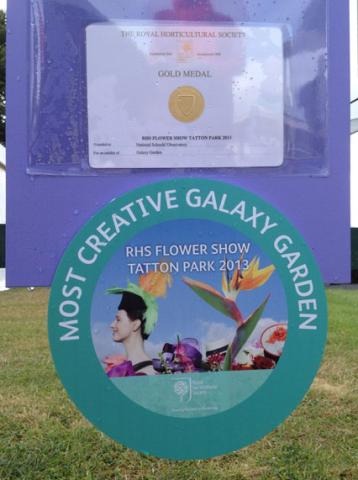 CreditThis work by The Schools' Observatory is licensed under All rights reserved
Feedback was positive and many wrote warm and enthusiastic messages in our garden comment book.
Image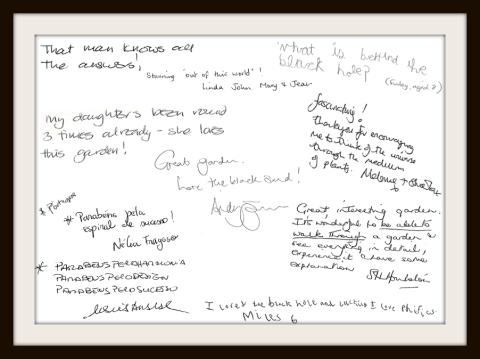 CreditThis work by The Schools' Observatory is licensed under All rights reserved
 - Project 2: Dark Matter – RHS Chelsea Flower Show (2015)
- Image
 CreditThis work by The Schools' Observatory is licensed under All rights reserved
Project Goal:
To explore the mystery of dark matter through garden design.
Duration:
6+ months of planning and construction.
Showcased 18–23 May 2015.
Target audience:
Public visitors to the RHS Chelsea Flower Show, including families, gardening enthusiasts, and curious learners.
Funders and partners:
The Schools’ Observatory at LJMU Astrophysics Research Institute, STFC (Science and Technology Facilities Council, RHS Landstruction, Dori & Howard Miller (Design & Horticulture), Asterios Agkathidis (Architectural Design), and Urbis Design.
Project Summary:
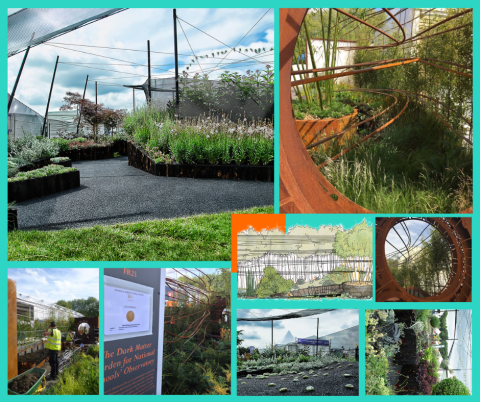
After our success at Tatton, we took on a bigger challenge at the RHS Chelsea Flower Show. We designed a garden about dark matter. The space was smaller, but the idea was bigger.
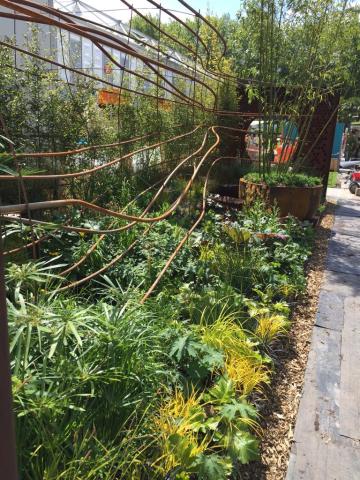
We worked again with Howard and Dori Miller and Landstruction, joined by new partners Asterios Agkathidis and Urbis Design. The garden used curved paths, stone textures, and gentle planting to show how dark matter bends light in space.
The project also marked 100 years since Einstein’s theory of general relativity, which first explained how gravity bends light. It was the perfect time to celebrate science through art.
Impact:
- Inspired visitors to learn about dark matter and astronomy
- Proved how art and science can work together
- Reached new audiences in creative ways
- Supported The Schools’ Observatory’s mission to make science for everyone
- The garden was relocated to a permanent home at the Daresbury Laboratories in Cheshire.
Highlights:
- Gold Medal & Best Fresh Garden at RHS Chelsea 2015
- Featured on national media, including BBC One, BBC Two, BBC Merseyside, BBC Wiltshire, and BBC News.
- Featured on international media, the estimated global TV audience (RHS official figures) was more than 200 million.
Quotes from the Press:
“A triumph. Wonderful design and certainly fresh!” — Paula McWaters
“Smart and beautiful.” — Toby Buckland
“An artistic interpretation of scientific principle, but scientifically sound.” — The Telegraph
Image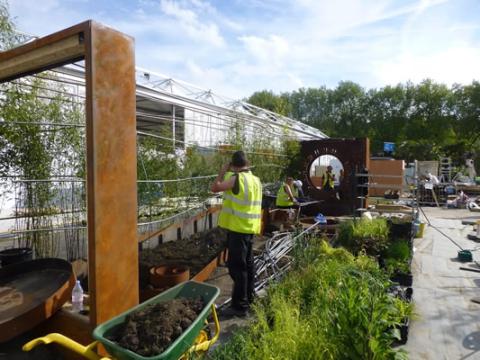 CreditThis work by The Schools' Observatory is licensed under All rights reserved
We are immensely grateful to everyone who contributed — from garden designers to scientists, from sponsors to suppliers. This was a true team effort that merged science, creativity, and public engagement in an unforgettable way.