The Schools' Observatory News
September 2026

Welcome Back!
We hope you had a well-deserved and relaxing summer break! Whether you spent your time travelling, exploring nature, or simply recharging, we hope it brought some sunshine and joy.
As the new school year begins, we’d like to wish you and your pupils a brilliant start to the term. We’re excited to continue supporting you with stellar resources, observing opportunities, and inspiring space science activities throughout the year.
New: Astronomy and Language!
Have you ever wondered why Monday is linked to the Moon, or why so many stars have Arabic names? Our new Astronomy and Language resource explores how looking at the sky has shaped the words we use across different languages and cultures.
Discover how the Sun helped shape words for directions in Welsh, explore the many names given to the Milky Way around the world, uncover the planets hidden in the days of the week, and learn the stories behind Arabic and Māori star names.
It’s a great way to explore the connections between astronomy, language, history, and culture, to show learners how our shared sky has influenced people around the world for thousands of years.
Explore Astronomy and Language.
Join the Neptune & Triton Experiment!
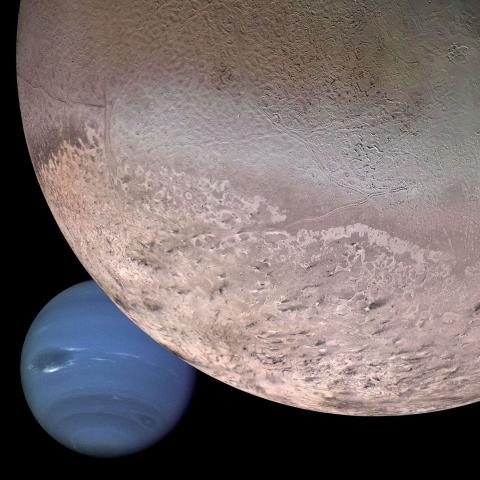
Here’s an exciting opportunity to follow 2 distant worlds across the night sky! Schools and educational groups are invited to take part in the Neptune/Triton Experiment, an international observing project running until January 2027.
The project is tracking Neptune as it moves through the constellation Pisces, while also following its largest moon, Triton, as it orbits the planet. There are lots of ways for students to get involved. You can explore real telescope images, create animations showing Neptune and Triton moving, investigate their speed and orbits, or even try calculating Neptune’s mass!
And here’s where The Schools’ Observatory comes in, you can use Go Observing and the 2-metre Liverpool Telescope to take your own images of Neptune and Triton and contribute to the experiment.
The invitation is available in 8 languages, making it a great opportunity for schools and learners around the world to take part.
Find out more and join the Neptune/Triton Experiment
Look Up! It’s International Observe the Moon Night
On 19 September, people around the world will come together for International Observe the Moon Night, a global celebration of lunar science, exploration, and our connections with the Moon.
It’s the perfect excuse to get your learners looking up! Whether observing the Moon outside or exploring it from the classroom, why not try some of our lunar activities?
- What Can We See on the Moon? – Explore the Moon’s surface and learn to identify some of its most noticeable features.
- Find the Moon Missions – Use real telescope images to find the landing sites of famous Moon missions.
- Measure Mountains on the Moon – Use shadows to calculate the height of mountains on the lunar surface.
- Maths with the Moon – Put maths skills into practice while exploring our nearest neighbour.
- Moonsaic – Piece together images of the lunar surface to create your own mosaic of the Moon.
- Go Observing – Request your own images of the Moon using a robotic telescope.
And don’t forget to simply step outside and look up, no telescope required! Explore more of our Moon resources and celebrate the night with us!
Astronomy in Every Language!
23 September is International Day of Sign Languages, celebrating the importance of sign languages and supporting the inclusion of Deaf people around the world.
Did you know that you can explore astronomy with us in British Sign Language (BSL)?
Our BSL videos introduce a range of space and astronomy topics, helping make learning about the Universe accessible to more people. From planets and stars to galaxies and the wider Universe, why not explore the videos with your learners and discover some astronomy in BSL?
Equal Day and Night? Explore the September Equinox!
On 23 September, we reach the September Equinox, marking the beginning of astronomical autumn in the Northern Hemisphere and spring in the Southern Hemisphere.
The equinox happens when the Sun crosses the celestial equator, meaning day and night are roughly equal in length around the world. It’s a great opportunity to explore Earth’s seasons, sunlight, shadows, and our planet’s journey around the Sun.
Try some of our related activities:
- Why Does the Earth Have Seasons? – Discover how Earth’s tilt causes the seasons.
- Explore Day and Night Around the World – Investigate how daylight changes depending on where you are on Earth.
- Why Do Shadows Change Over Time? – Observe how the Sun’s position changes the length and direction of shadows.
- Make a Sundial – Use sunlight and shadows to explore one of the oldest ways of measuring time.
The equinox has also been important to cultures around the world for thousands of years, influencing calendars, festivals, farming, and traditions. Explore our Cultural Astronomy resources to discover how people around the world have used the changing skies to mark the seasons and the passing of time.
Look to the Sky!
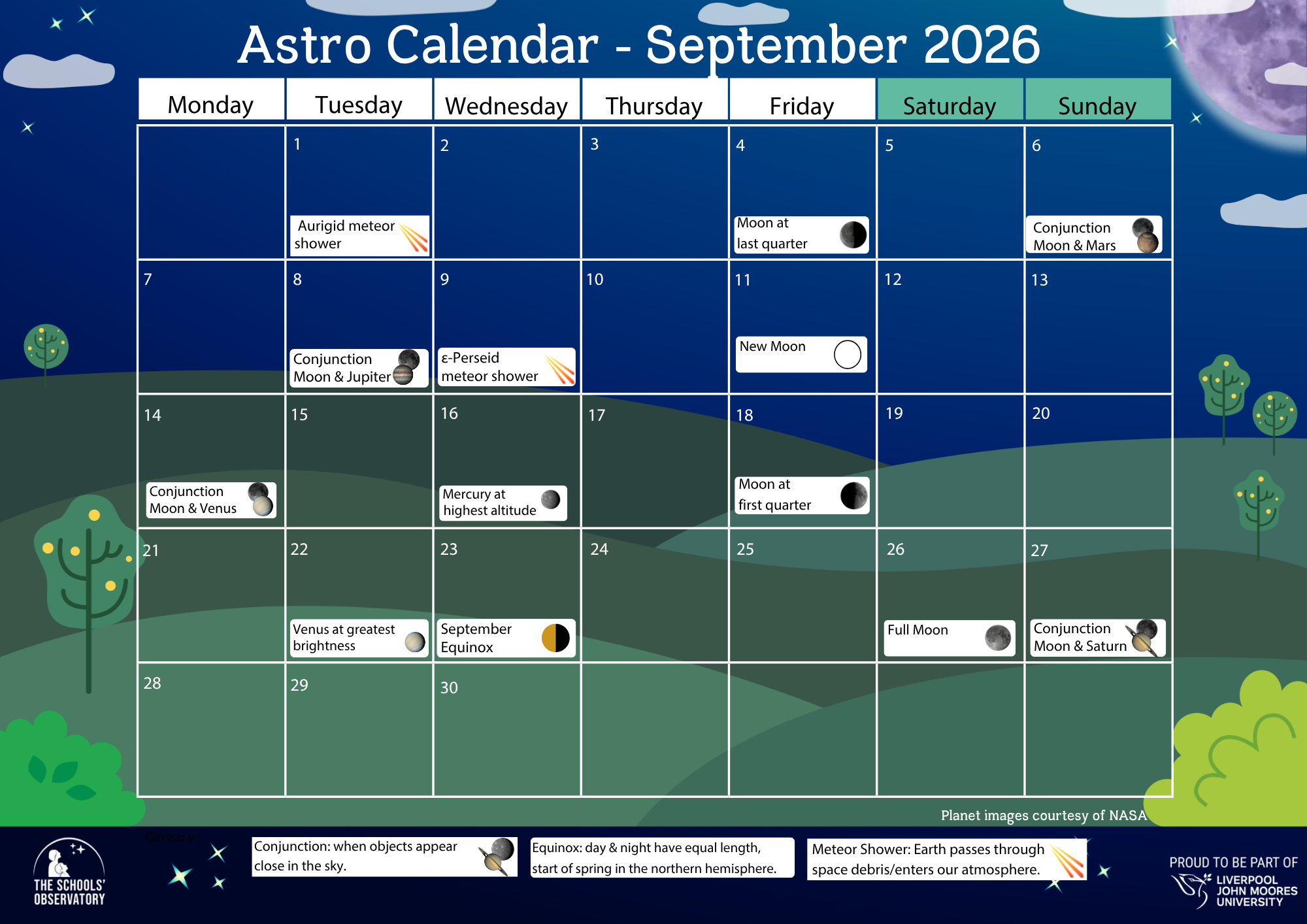
Plan your stargazing adventures with our September astronomy calendar! Download it to display at home or in the classroom. Get ready for an exciting month of celestial events, including Meteor showers and conjunctions between the Moon and some of the Solar System’s most impressive planets. Don’t miss out on what the night sky has to offer!
Download and display September's astronomy calendar!