
The sky has shaped the way we speak for thousands of years. Words for stars, planets, directions, days, and seasons often have links to astronomy.
These links can be found in languages across the world. A familiar word may tell us how people once used the Sun to find direction. The name of a day may come from a planet. Even the Milky Way has many different names and meanings.
In this section, you can explore how astronomy has shaped language. It shows how words we use every day are linked to old ideas about the sky. Every time we speak them, we're keeping this history alive.
- Left, Right and the Sun in Welsh
The Welsh language holds an interesting clue about how people once found direction. The Welsh word 'de can' means both south and right. This link makes sense when we look at the rising Sun. Imagine standing outside and facing east, towards the sunrise. South is now on your right-hand side. North is on your left. In older ways of finding direction, east was often an important starting point. The rising Sun gave people a clear sign of which way they were facing.
Welsh also holds a link between north and left. The modern Welsh word for north is 'gogledd'. It is linked to an older Welsh word, 'cledd', meaning left. Today, the usual Welsh word for left is 'chwith', so the link is less easy to spot.
Image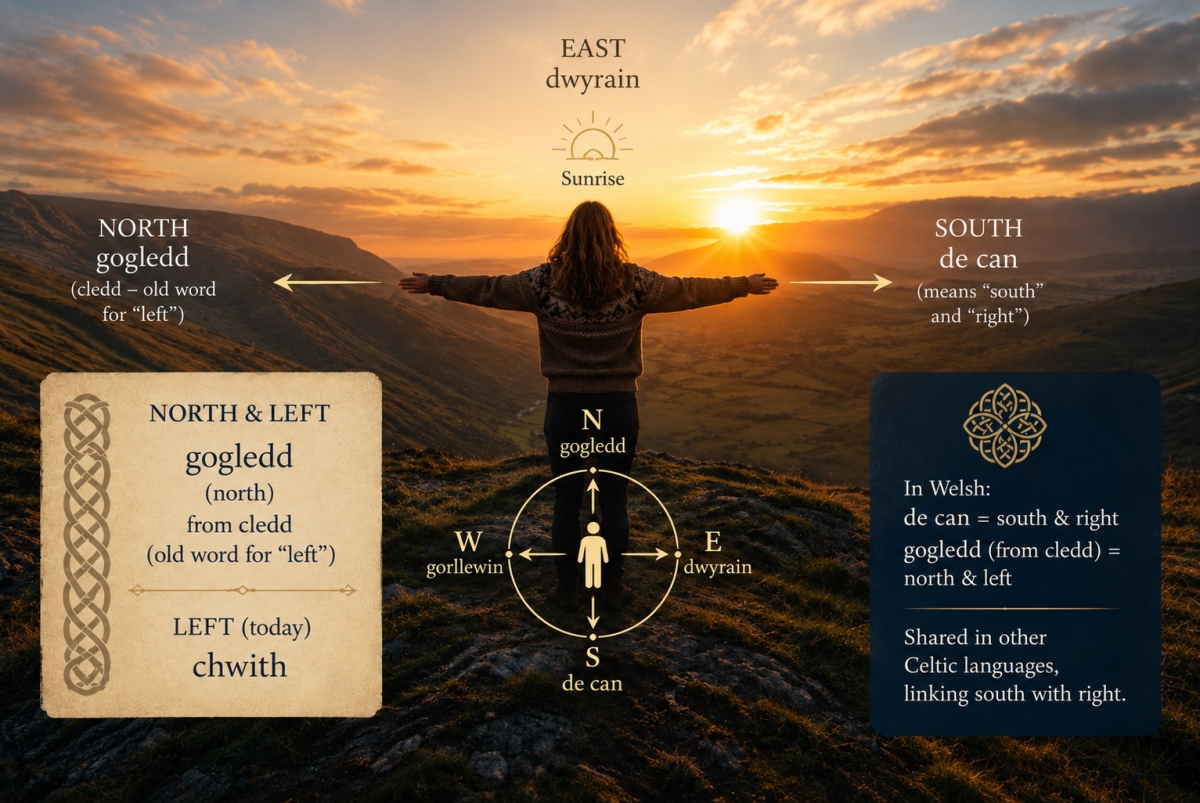 CreditThis work by The Schools' Observatory is licensed under All rights reserved
These links are not unique to Welsh. Similar patterns can be found in other languages. Irish and some other Celtic languages also connect south with the right-hand side. This may reflect a very old way of using the Sun and the human body to understand direction.
Welsh gives us a small example of how astronomy can live inside language. Words that we use today can hold clues about how people watched the sky and found their way in the past.
- The Milky Way Around the World
On a dark night, you may see a pale band of light across the sky. This is the Milky Way. It is our home galaxy, seen from inside it. Long before people knew this, cultures around the world gave it their own names.
Image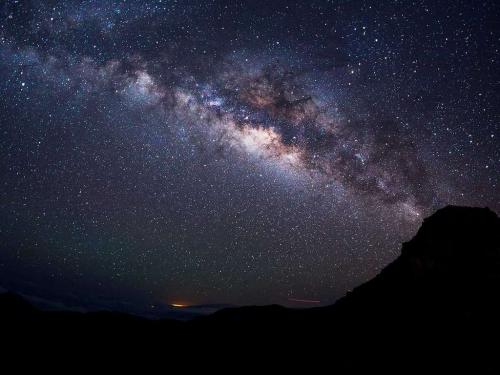 CreditThis work by National Parks Gallery is licensed under GNU General Public License v2.0 or later
In English, we call it the Milky Way. The name has roots in an ancient Greek story about milk spread across the sky. The word galaxy also comes from a Greek word linked to milk.
In China, the Milky Way is known as the Silver River (Yínhé). It appears in the famous story of the Weaver Girl and the Cowherd. The two lovers are separated by this river in the sky. They are allowed to meet once each year.
In Japan, it is called Amanogawa, which means the River of Heaven. The Milky Way also plays a part in the story of the Tanabata festival. Like the Chinese name, it pictures the stars as a great river across the sky.
In India, the Milky Way is often called Akash Ganga, meaning the Ganga of the Sky. The name links it to the sacred River Ganges. In Hindu tradition, Ganga has a strong link with the heavens. The bright band of the Milky Way can be seen as a river flowing through the night sky.
In Arabic, a traditional name is Darb al-Tabbāna, or the Path of Straw. The name pictures straw spread along a path. Its pale trail across the sky may look like scattered pieces of straw.
Other cultures have their own names for the Milky Way. Some see a river, while others see a road, path, or trail. These names often reflect the land, stories, and daily lives of the people who created them.
Today, we know that the Milky Way contains billions of stars. Yet its many names tell us another story. People around the world looked at the same sky but saw it in different ways. Their words help keep those different views of the night sky alive today.
- Planets in the Days of the Week
Have you ever wondered why the days of the week have their names? In many languages, the answer can be found in the sky. Ancient people knew seven objects that seemed to move across the sky. These were the Sun, Moon, Mars, Mercury, Jupiter, Venus, and Saturn. Each became linked with a day of the week. We can still see this link clearly in several European languages.
In French, Monday is Lundi, linked to Luna (which is another name for the Moon). Tuesday is mardi, linked to Mars. Wednesday is mercredi, linked to Mercury. Thursday is jeudi, linked to Jupiter. Friday is vendredi, linked to Venus.
The pattern is also found in Spanish. Monday is lunes, Tuesday is martes, Wednesday is miércoles, Thursday is jueves, and Friday is viernes. These names have links to the Moon and the same four planets.
English followed a similar pattern, but some Roman gods were replaced by gods from Germanic traditions. Tuesday is linked to Tiw, Wednesday to Woden, Thursday to Thor, and Friday to Frigg. These gods were matched with Roman gods linked to Mars, Mercury, Jupiter, and Venus. Some links are easier to see in English. Saturday comes from Saturn. Sunday means the Sun's day, while Monday means the Moon's day.
The idea also appears beyond Europe. In India, traditional names for the days are linked to the same seven objects. For example, Somavara is linked to the Moon, while Mangalavara is linked to Mars.
These names show how closely people once connected time with the sky. We may use a phone or calendar to check the day today. Yet every time we name a day of the week, we are using words with an old link to astronomy.
Image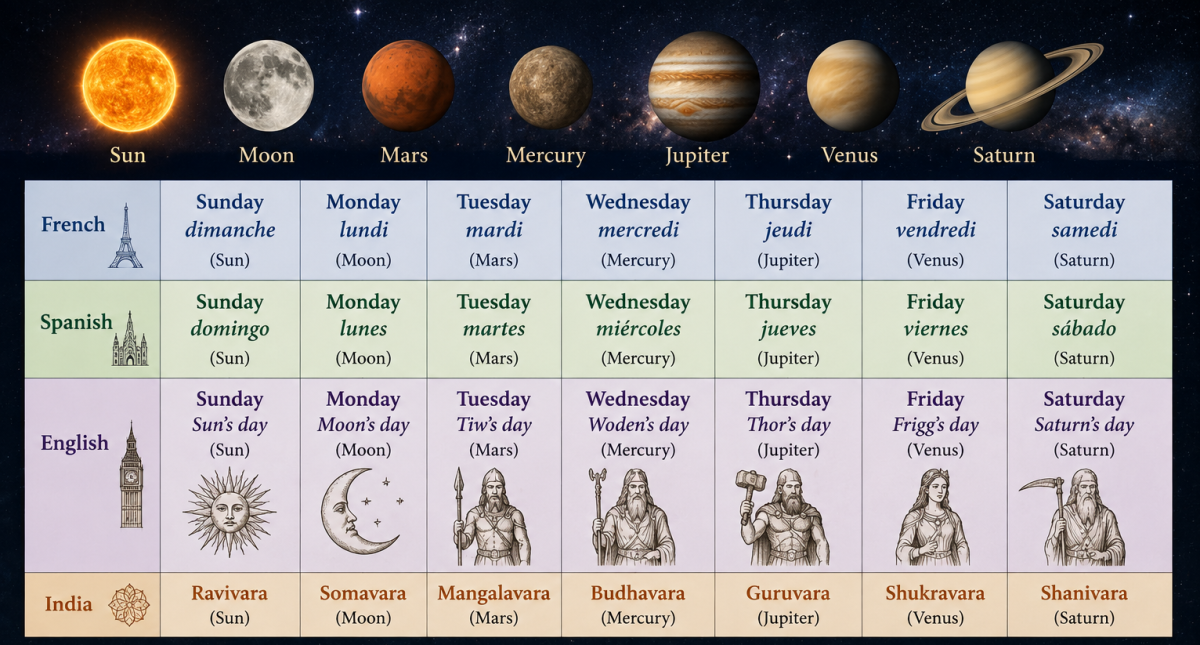 CreditThis work by The Schools' Observatory is licensed under All rights reserved
- Arabic Star Names We Still Use Today
Look at a modern star map and you may find names such as Aldebaran, Altair, Deneb, and Betelgeuse. These names have Arabic roots. They are part of a long history of astronomy in the Arabic-speaking world. From around the 8th century onwards, scholars in the Islamic world studied the night sky in great detail. This includes people like Abd al-Raḥmān al-Ṣūfī and Al-Battani. They translated earlier astronomy texts into Arabic. They also made their own observations, improved star charts, and wrote books about the stars.
Many Arabic star names describe the position or appearance of a star. Others are linked to the shape of a constellation. Aldebaran comes from the Arabic al-Dabarān, meaning “the Follower.” The name may describe how the star appears to follow the Pleiades across the sky.
Altair comes from an Arabic name meaning “the Flying Eagle.” It is the brightest star in the constellation Aquila, the Eagle. Deneb comes from the Arabic word dhanab, meaning “tail.” The star marks the tail of the Swan in the constellation Cygnus. The same Arabic word appears in the names of several other stars.
Betelgeuse also has an Arabic name. It comes from a phrase linked to the hand or shoulder of al-Jawzāʾ, a figure in Arabic sky traditions. Today, Betelgeuse marks the shoulder of Orion.
Image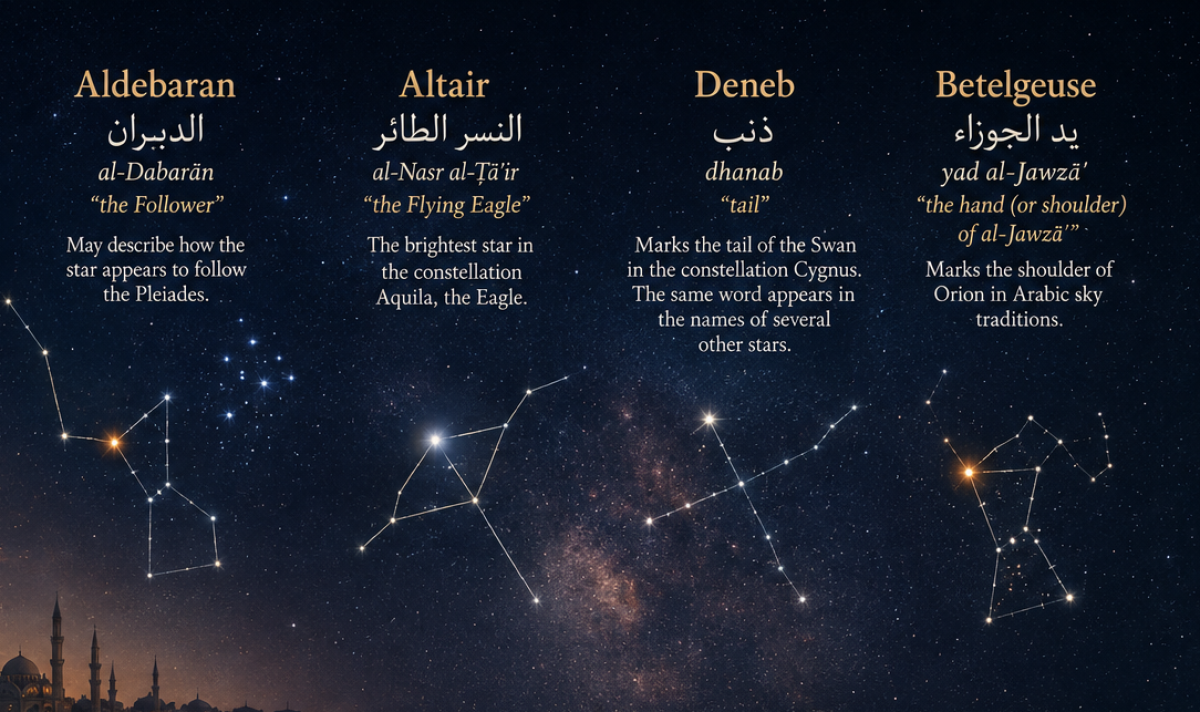 CreditThis work by The Schools' Observatory is licensed under All rights reserved
So how did these Arabic names become part of astronomy today? During the Middle Ages, Arabic astronomy books were translated into Latin. European astronomers studied these works and adopted many of the star names. Over time, their spelling and sound changed. This history is still visible when we look at the sky.
Arabic star names remind us that astronomy has grown through the work of many cultures. They also show how scientific ideas and the words used to describe them can travel across languages and across centuries.
- Māori Names for the Stars
For Māori in Aotearoa New Zealand, the night sky holds a rich record of knowledge. Stars have names and meanings that have been passed down for many generations. They helped people mark the seasons, plan activities, and understand the world around them.
One of the best-known names is Matariki. This is the Māori name for the star cluster also known as the Pleiades. Its appearance in the early morning sky during winter marks the Māori New Year for many communities. Matariki is also the name of one star within the cluster. In some Māori traditions, other stars in the group have their own names. These include Tupuānuku, Tupuārangi, Waitī, Waitā, Waipuna-ā-rangi, Ururangi, Pōhutukawa, and Hiwa-i-te-rangi.
Different iwi, or Māori communities, may have their own names and traditions. The stars can have links to the natural world. Tupuānuku, for example, is linked to food grown in the ground. Waitī is linked to fresh water and the food within it. Waitā has links to the ocean. Ururangi is linked to the winds.
Image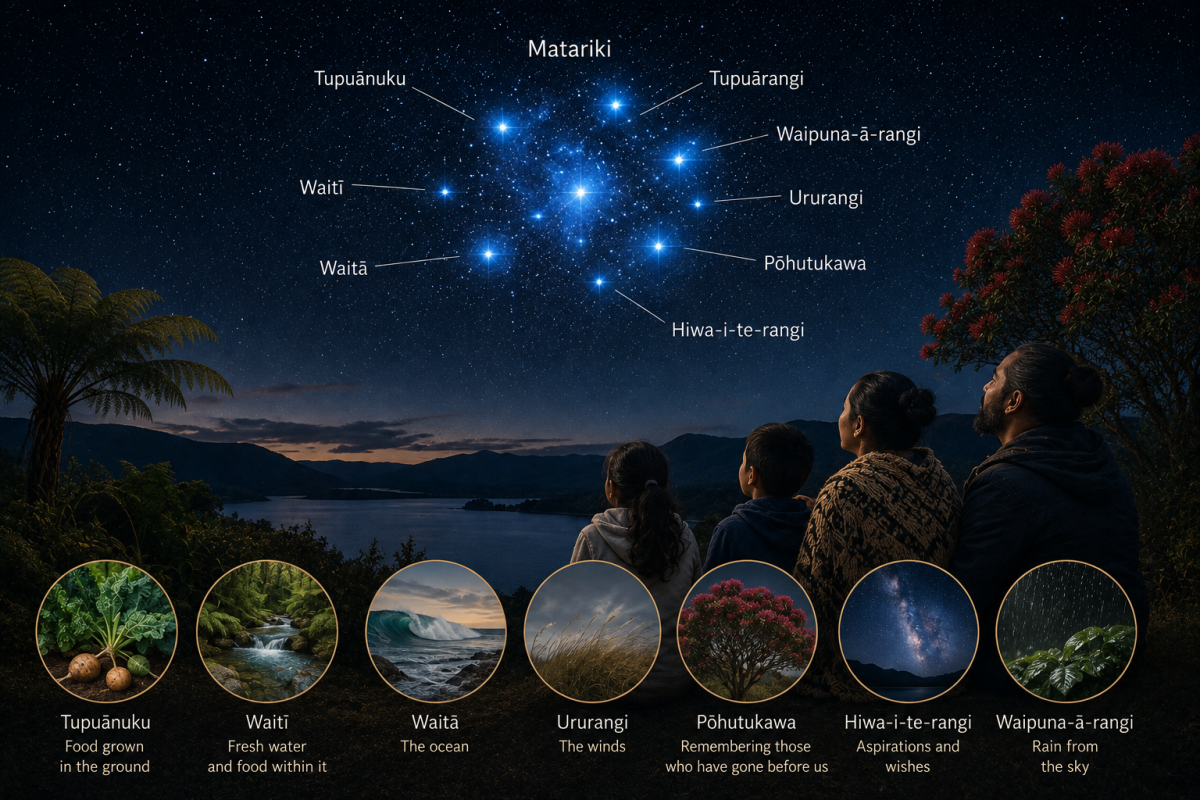 CreditThis work by The Schools' Observatory is licensed under All rights reserved
Māori also have names for many other stars and groups of stars. Puanga, known as Rigel in Western astronomy, is important in some parts of Aotearoa. In areas where Matariki is hard to see, the appearance of Puanga may be used to mark the new year.
Star names were part of a wider system of knowledge called mātauranga Māori. People watched the sky alongside changes in plants, animals, weather, and the sea. This knowledge helped communities understand the changing seasons.
Today, names such as Matariki are widely used across Aotearoa New Zealand. Matariki became a public holiday in New Zealand in 2022. The names of the stars continue to share Māori knowledge, language, and connections with the sky.
- Sun and Moon in Our Words
The Sun and Moon have been part of human life for thousands of years. People used them to mark time, follow the seasons, and understand the sky. Their importance can still be found in many words we use today. The word solar comes from the Latin word sol, meaning Sun. We use it in terms such as Solar System, solar eclipse, and solar energy. The Sun also gave us the word Sunday, which simply means the Sun’s day.
The word lunar comes from the Latin word luna, meaning Moon. We still use it when we talk about a lunar eclipse, a lunar calendar, or the lunar surface. The Moon also has a link to the word month. This comes from an old Germanic word linked to the Moon. This connection makes sense. A lunar cycle lasts about 29.5 days, which is close to the length of a month.
We can find similar links in other languages. In French, the Moon is lune, while in Spanish and Italian it is luna. These words share the same Latin roots. In Arabic, the word for Moon is qamar (قمر). This appears in other words linked to the Moon. The word for Sun is shams (شمس). Both words are also used in names, poems, and everyday expressions.
In Hindi, the Moon can be called Chandra, a name with roots in Sanskrit. The Sun is often called Surya. Both names have a long history and appear in Indian culture, religion, and astronomy.