The Schools' Observatory News
June 2026

New Things To Do: Measure the Brightness of a Variable Star!
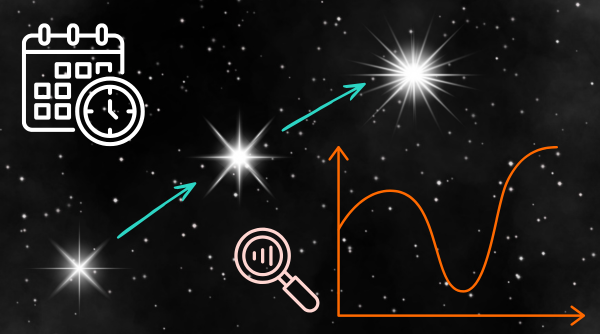
We’ve just published a brand-new Things To Do resource: Measure the Brightness of a Variable Star. Aimed at students aged 14 to 18, this activity gives learners the chance to work like real astronomers by measuring how the brightness of a star changes over time.
Using our AstroLab software, students will carry out photometry on the variable star W UMa and 2 comparison stars. They will then enter their measurements into a prepared Excel spreadsheet, which automatically creates a light curve as the data is added. This light curve helps students see how W UMa changes in brightness and allows them to investigate its repeating pattern.
Students then use our Learn section to research common types of variable stars and compare what they discover with their own results. By the end of the activity, students will use real data, analysis skills, and scientific reasoning to classify W UMa as a type of variable star.
It’s a great way to introduce students to data analysis, stellar astronomy, and the way astronomers study stars that change over time.
Help Us Grow: Join Our Online Focus Groups this Month!
We’re always looking for ways to make The Schools’ Observatory better for you and your students and we’d love your help.
The Schools’ Observatory is free to use, thanks to generous funding from Liverpool John Moores University (LJMU). Our telescope time is also kindly supported by LJMU (via the Liverpool Telescope) and the Dill Faulkes Educational Trust (via the Las Cumbres Observatory Network).
Our mission is simple: to provide free, high-quality resources that inspire young people to think about STEM careers and support educators in teaching STEM subjects. To do this well, we need to understand the impact we’re having.
That’s why we’re inviting educators of students aged 8-16 to take part in online focus groups between June - July 2026, led by the LJMU School of Education, who are helping us evaluate and improve the service. Each session would take approximately 20 minutes of your time. You would be asked to answer questions regarding your use of resources and telescope observations from The Schools' Observatory website.
If you’d like to share your thoughts, experiences, and ideas, we’d really appreciate your time. Register your interest by filling in this form before 10th June 2026.
Your feedback helps shape what we do next and thank you for being part of our journey!
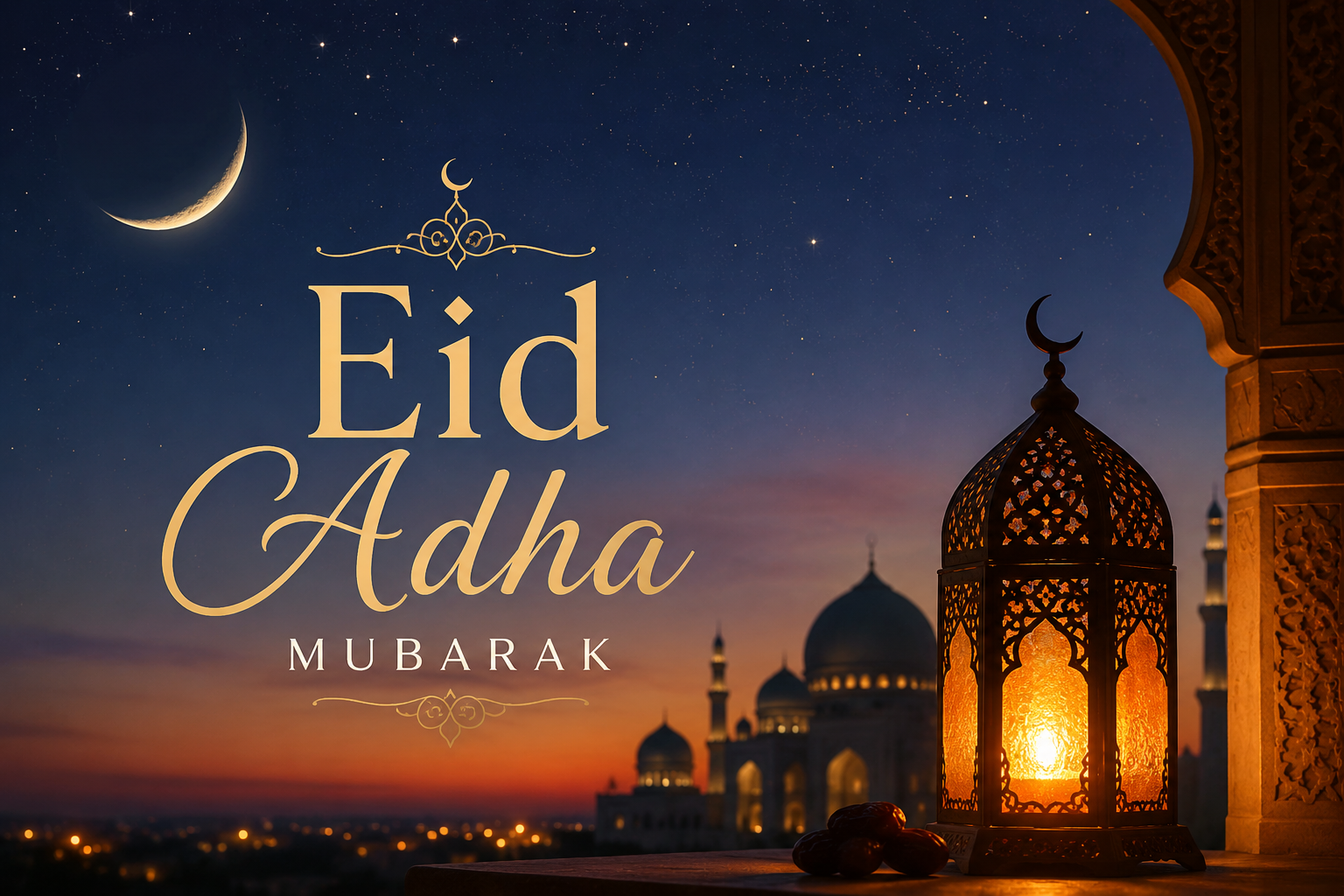
Eid Al-Adha Mubarak!
To all those celebrating, we wish you a joyful and peaceful Eid al-Adha, which begins this year on the evening of 26th May and lasts until the 30th May.
Did you know that astronomy plays an important role in marking Islamic festivals like Eid?
The Islamic calendar is a lunar calendar, which means months begin with the sighting of the new crescent Moon. Skilled observers look to the evening sky for the first glimpse of the Moon to confirm the start of a new month, blending ancient tradition with modern astronomy.
This is a wonderful opportunity to talk to your students about how different cultures use the skies to guide timekeeping, celebrations, and daily life. Explore more about Islamic astronomy and other cultural events in our Cultural Astronomy section.
World Environment Day!
World Environment Day is marked each year on 5th June. It is a global reminder of the importance of protecting our planet. This year’s theme focuses on restoring land and building resilience against drought – issues that are deeply connected to life on Earth.
Why not use this as a chance to explore what makes our planet so special, and how conditions here compare to those elsewhere in the Universe? Our activities can help you dig deeper into these questions:
- Hot, Cold, or Just Right? – Compare different planets to Earth and explore what conditions make a world habitable.
- Investigate How the Sun Supports Life – Discover how sunlight helps plants make food and produce oxygen.
- Life on Earth – Explore the unique combination of elements that support life here.
- What Does Life Need? – Learn about the key ingredients for life and consider whether we might find them elsewhere.
World Oceans Day
Each year on 8th June, World Oceans Day reminds us of the vital role oceans play in supporting life on Earth. Oceans help regulate our climate, provide food and oxygen, and are deeply connected to the Moon through the phenomenon of tides.
Why not dive into this theme with your students and explore the link between astronomy and the sea?
- Why Does Earth Have Tides? – Discover how the gravitational pull of the Moon and Sun creates tides on Earth through an interactive simulation.
- Explore Tides – Build a model to explore the gravitational effects of the Moon and Sun on Earth's tides. Learn about different types of tides.
- Investigate Tides – Use predicted tidal data to explore how tides change over time. Analyse the graph to spot patterns and make predictions.
The June Solstice
The June Solstice falls on 21st June and marks the longest day of the year in the Northern Hemisphere, bringing the start of summer. Meanwhile, in the Southern Hemisphere, it is the shortest day and the beginning of winter. This is a perfect time to explore how Earth's tilt and orbit create the seasons and change the way we experience daylight and shadows.
Discover our top Things To Do resources to help your learners understand the science behind this seasonal event:
- Why Does Earth Have Seasons? – Watch this short animation to discover how Earth's tilt causes the seasons.
- Why Do We Have Seasons? – Use this interactive animation to explore how sunlight changes across the globe.
- Explore Day and Night Around the World – Investigate how Earth's rotation creates day and night in different places.
- Why Do Shadows Change Over Time? – Learn how the position of the Sun in the sky changes the shape and length of shadows.
You can also explore how different cultures have marked the solstice in our Cultural Astronomy section.
Women in Engineering Day
23rd June is Women in Engineering Day, a chance to spotlight the amazing women shaping our world through creativity, innovation, and science.
Explore the journeys of some of our inspiring career heroes:
- Mary Jackson – NASA’s first Black female engineer, who also supported young people in STEM through community science clubs.
- Mimi Aung – An engineer behind the first Mars helicopter flight, named one of the BBC’s top 100 women in 2019.
Don't miss our famous activity, Design a Telescope –– Discover what engineers and astronomers must consider when building new telescopes.
International Asteroid Day
On 30th June, we turn our eyes to space for International Asteroid Day — a global event to raise awareness about asteroids and the role they play in our Solar System. These space rocks hold clues to the formation of our Solar System and can even pose a risk to life on Earth.
Explore our asteroid-themed activities:
- What are Asteroids and Comets? – Learn about these rocky visitors from space and how they formed.
- What are the Risks from Asteroids? – Discover how likely it is that an asteroid could impact Earth and what scientists are doing to prepare.
- Hunt for Asteroids – Use real telescope images to search for moving objects in space!
- Make Your Own Asteroid Impact – A hands-on experiment to explore what happens when asteroids hit planetary surfaces.
- Asteroid Watch Project – Take part in a real observing project and use telescope images to help track asteroids close to Earth.
Celebrating Pride Month!
June is Pride Month, a time to celebrate the contributions, courage, and visibility of LGBTQ+ individuals across all fields — including science, astronomy, and engineering.
Let us shine a light on just a few of the inspiring LGBTQ+ scientists who have shaped our understanding of the Universe:
- Jan Eldridge – Astrophysicist and passionate advocate for diversity and inclusion in science.
- Alan Turing – Groundbreaking mathematician and codebreaker, whose ideas laid the foundation for modern computing.
- Lisa Harvey-Smith – Astrophysicist and author, championing gender equity in STEM.
- Nergis Mavalvala – Physicist whose work was crucial in detecting gravitational waves.
- Sally Ride – The first American woman in space and a powerful advocate for science education and LGBTQ+ representation.
Their achievements remind us that science is for everyone — and that diversity fuels discovery!
Look to the Sky!
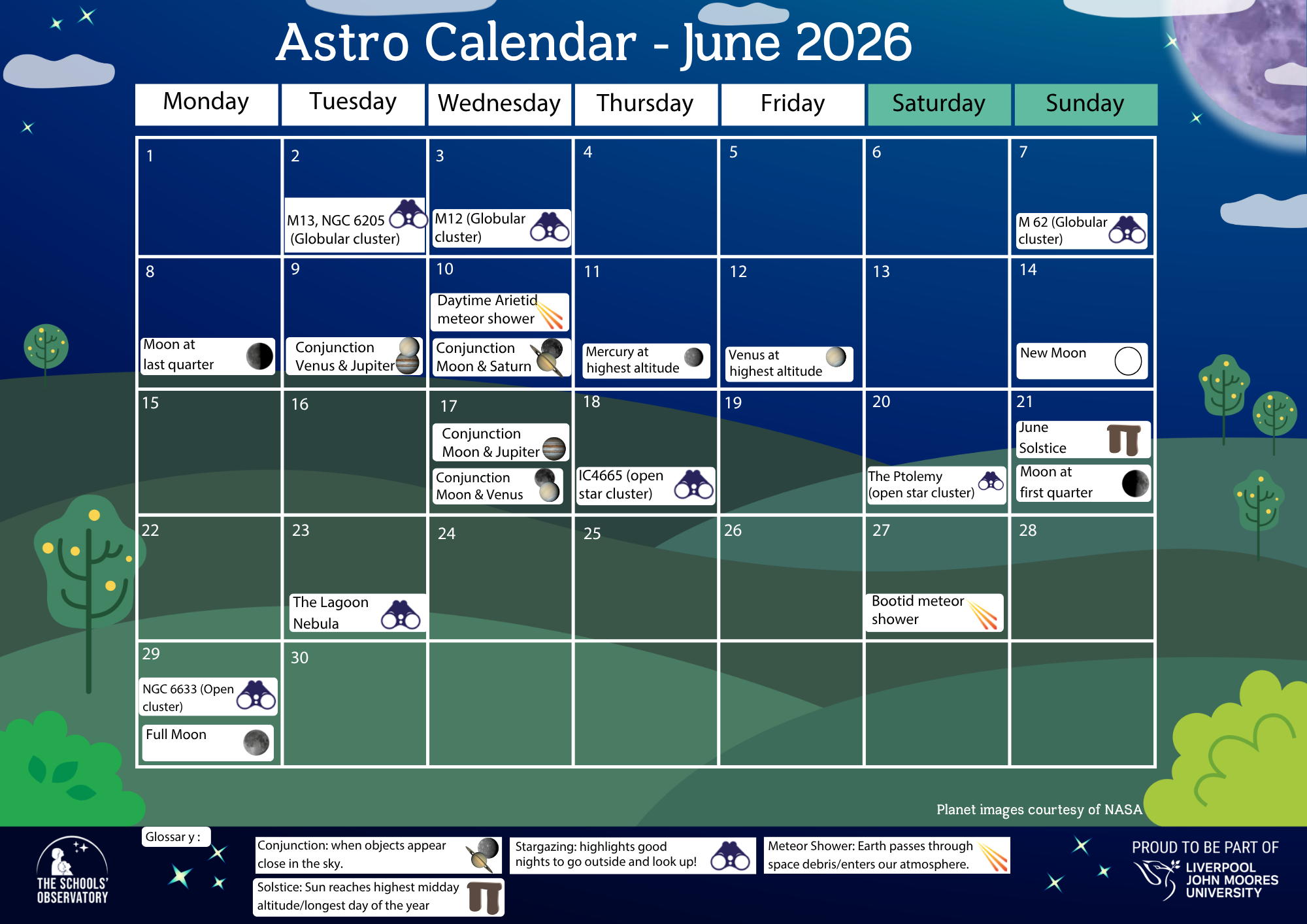
Plan your stargazing adventures with our June astronomy calendar! Download it to display at home or in the classroom. Get ready for an exciting month of celestial events, including Meteor showers and conjunctions between the Moon and some of the Solar System’s most impressive planets. Don’t miss out on what the night sky has to offer!
Download and display June's astronomy calendar!