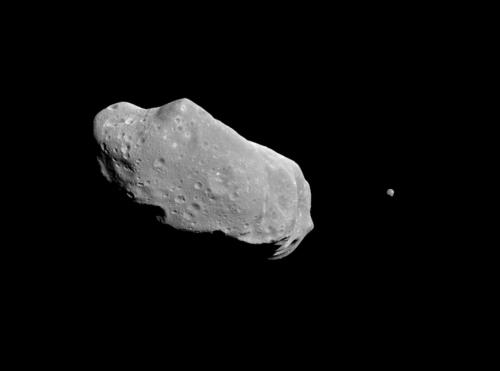
Asteroids are small, rocky objects that orbit the Sun. They are ancient leftovers from the start of the Solar System. This means they contain the same material which built the rocky planets, such as Earth or Mars.
Astronomers have found more than one million asteroids so far. 20,000 of them have names, and the rest have identifying numbers.
Most are located between the orbits of Mars and Jupiter. This area of our Solar System is known as the Asteroid Belt. However, if gravity from the Sun or inner planets pull them out of place, or if they collide with another asteroid and are knocked towards the Sun, this brings their orbits much closer to Earth. These are known as Near Earth Objects or NEOs.
An NEO's orbit takes it within 1.3 AU of the Sun. The largest known NEO is over 40 km in diameter, but astronomers have found thousands of NEOs with diameters larger than 1 km. Anything smaller is too hard to see.
Astronomers track NEOs in case they could be a threat to our planet in the future. In this project, you will learn how to identify an asteroid in a set of telescope images, use Go Observing to request observations of a NEO, and search the data to identify its position.
By the end of this activity you will:
- Know how to use image software to open, view and analyse data
- Have used Go Observing to request observations of a NEO
- Have searched for asteroids yourself
- Have measured the positions of any NEOs you detect
To complete this activity you will need:
- Access to Go Observing through your Schools’ Observatory log in
- The Asteroid Watch research project webpages
- Online access to AstroLab
- The example data of asteroid 138205 (2000 EZ148)
- The Asteroid Position Table
Use the items in the menu to:
- Learn how to spot an asteroid in observation images
- Read through the instructions
- Know the answers to some common questions about the project