
Here are the answers to some common questions:
- Why is my image just a black square?
You may not have scaled your image enough. Remember to use the Display>Scaling tool in AstroLab to move down the maximum value, but don't move the minimum value up too far, or you may lose the asteroid again!
- Why do the stars look like they're jumping back and forth when I "blink" through the images?
You may have opened the images in the wrong order. Check the numbers at the end. They go from 000 to 005.
Also, remember to only "blink" through the short-interval data or the long-interval data i.e. don't blink through all the images at once. The short-interval data is images 000 to 002 and the long-interval data is images 003 to 005.
- Why can't I see an asteroid in either set of images?
Sometimes, an asteroid is really tricky to spot! This could be for a number of reasons.
Perhaps the asteroid is traveling through a crowded part of the sky. Look at the picture below. The section of sky on the right has far more stars than the part imaged on the left. An asteroid would be much more difficult to find.
Image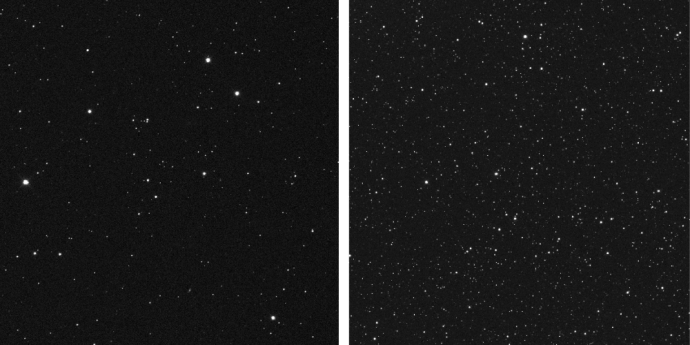 CreditThis work by The Schools' Observatory is licensed under All rights reserved
The section of sky on the right is far more crowded with stars than the section of sky on the left The asteroid might not be as bright as the stars around it either. This could be due to the asteroid itself being particularly small or dark, or if it was imaged at an angle when it's not reflecting a lot of light from the Sun.
If you can't find an asteroid in your data, you can request the observation again and see if you can spot it in another data set.
- Log in to your account.
- Choose ‘My Observations’ in the Go Observing menu.
- In the ‘Actions’ column, click the resubmit arrow ( ) for the observation you want to repeat.
- I'm stuck - where can I get help?
If you have a problem, please get in touch. In your message, please include where you have got to within the project, the name of the asteroid you have data for, and what went wrong. You can contact us by emailing SchoolsObs@ljmu.ac.uk.