The Schools' Observatory News
November 2026

World Science Day: Science Without Borders!
On 10th November, we celebrate World Science Day for Peace and Development, a UNESCO initiative that highlights the important role science plays in our lives and how working together can help us tackle global challenges.
Astronomy is a wonderful example of science bringing people together. Scientists from different countries share discoveries, combine their knowledge and use telescopes around the world to explore the Universe. After all, we may live in different places, but we all share the same sky!
At The Schools’ Observatory, we believe everyone should have the chance to explore space, wherever they are. Here are a few ways to bring the spirit of scientific discovery and collaboration into your classroom:
- Go Observing – Give your students the chance to request real observations using professional robotic telescopes around the world.
- Career Heroes – Meet scientists, engineers and space professionals from different countries and backgrounds, and discover the many people behind scientific discoveries.
- Cultural Astronomy – Explore how people around the world have observed, understood and shared knowledge about the night sky.
- Space for Everyone Quiz – Challenge students to think about who can take part in space science and discover why space should be for everyone.

World Philosophy Day: Big Questions About the Universe!
Are we alone in the Universe? Should humans live on Mars? Does space exploration benefit everyone? Some questions do not have simple answers, and that is what makes them so interesting!
On 19th November, we celebrate World Philosophy Day, an opportunity to encourage curiosity, critical thinking and open discussion. Astronomy and philosophy have been closely connected for thousands of years, as people across different cultures have looked up at the night sky and wondered about our place in the Universe.
Why not turn your classroom into a space for big questions and lively discussions with some of our resources?
- Host a Space Debate – Encourage students to explore different views on space exploration, build arguments and practise listening to others.
- You Decide! Should We Explore Space? – Explore the benefits and challenges of space exploration and let students form their own opinions.
- What Does Life Need? – Get students thinking about what makes a planet suitable for life and whether life elsewhere might look different from life on Earth.
- Search for Life – Explore how scientists look for signs of life beyond Earth and what finding it might mean for our understanding of the Universe.
This World Philosophy Day, remind your students that science is not just about finding answers, but also about asking questions, sharing ideas and discovering things together!
World Children's Day: Big Dreams Start with Little Questions!
Every great discovery begins with curiosity, and children are certainly full of it! From wondering why the Moon changes shape to asking whether aliens exist, their questions remind us that there is always something new to explore.
On 20th November, we celebrate World Children's Day, a day dedicated to children's rights, wellbeing and opportunities. It is also a chance to recognise the importance of giving every child the freedom and confidence to ask questions, explore their interests and dream big.
At The Schools’ Observatory, we believe that space is for everyone, and every child deserves the chance to discover the wonders of the Universe. Here are a few activities to help inspire your young explorers:
- Space Jobs Game – Discover the many different careers in the space sector and the skills needed for each one.
- Colour Your Space – Let students get creative and bring the wonders of space to life with colour.
- Design a Planet – Encourage students to use their imagination and scientific knowledge to create their very own planet.
- Cosmic Yoga – Take a break from the classroom and explore space through movement, stretching and yoga.
- Just for Fun – Discover a collection of space-themed games, puzzles and activities for curious minds.
- Stars and Stories – Explore the night sky through storytelling and discover how stars can inspire imagination and creativity.
Who knows? The next great space discovery might begin with a question asked in your classroom today!

November Supermoon: A Bigger, Brighter Moon!
Have you ever looked up at the Full Moon and thought it seemed unusually big or bright? You might have spotted a supermoon!
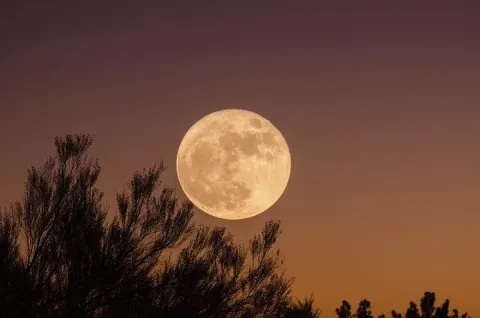
On 24th November, we will be treated to a supermoon, when the Full Moon occurs close to the point in its orbit where it is nearest to Earth. This makes it appear slightly larger and brighter than an average Full Moon, although the difference can be tricky to spot with the naked eye.
It is a great opportunity to encourage your students to look up at the night sky and learn more about our closest celestial neighbour. Why not explore the Moon with some of our activities?
- Moon Diary – Encourage students to observe the Moon over several nights, record what they see and discover how its appearance changes.
- Why Does the Moon Have Phases? – Explore why the Moon appears to change shape as it travels around Earth.
- Explore the Moon’s Surface – Take a closer look at the Moon's craters, mountains and dark plains.
- Measure Mountains on the Moon – Use real images and shadows to work out the height of mountains on the lunar surface.
And here is a question for your students: If the Moon is closer to Earth during a supermoon, does that mean it actually gets bigger, or does it just look bigger?
Red Planet Day – Celebrating Mars!
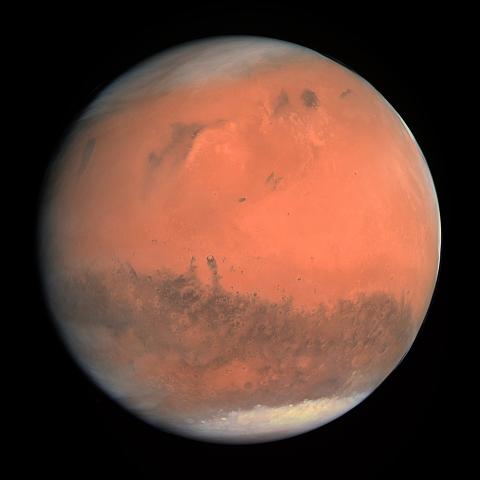
Every year on 28th November, we celebrate Red Planet Day in honour of the launch of Mariner 4, the first spacecraft to successfully fly by Mars. Launched in 1964, Mariner 4 reached Mars on 14th July 1965, capturing 22 close-up images of the Martian surface—the first of their kind from deep space! This historic mission marked the beginning of our journey to understand Mars and paved the way for future exploration.
Get your students involved in celebrating Mars with these fun Things To Do activities:
- Calculate Your Weight on Mars: Discover how much you’d weigh on the Red Planet!
- Calculate the Speed of Mars: Learn about Mars’s orbit and speed in our Solar System.
- Explore Gravity on Mars: Find out how gravity on Mars compares to Earth’s.
- Investigate: Measure the Size of Mars: Learn techniques to measure the size of Mars.
- In our Learn pages section, you can also explore more about Mars, and Mars's Moons.
Look to the Sky!
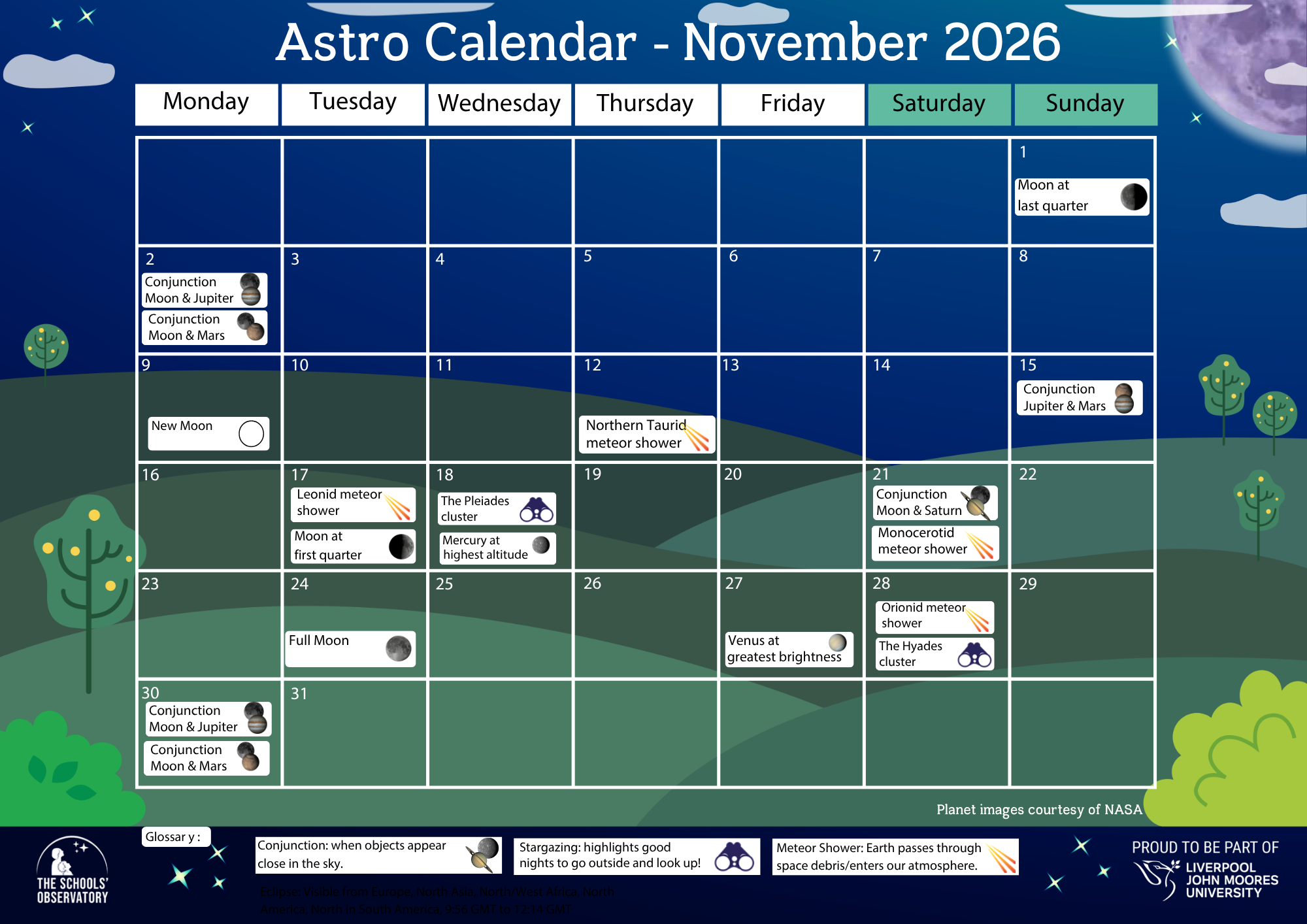
Plan your stargazing adventures with our November astronomy calendar! Download it to display at home or in the classroom. Get ready for an exciting month of celestial events, including Meteor showers and conjunctions between the Moon and some of the Solar System’s most impressive planets. Don’t miss out on what the night sky has to offer!
Download and display November's astronomy calendar!