The Schools' Observatory News
March 2026

Celebrating the Sky Across Cultures!
This month, many communities around the world are marking important cultural celebrations connected to the sky, including Ramadan, the Lunar New Year, and Nowruz.
Ramadan begins with the sighting of the crescent Moon, highlighting how lunar phases have shaped calendars and traditions for thousands of years. The Islamic calendar is based on the Moon, and careful sky observation continues to play an important role in marking this special month.
The Lunar New Year is observed across many cultures and regions worldwide, including China, Vietnam, Korea, and other parts of East and Southeast Asia. While it is most popularly associated with China, it is part of a much wider tradition of lunisolar timekeeping, guided by the cycles of the Moon and the Sun.
Nowruz, celebrated in Iran and across parts of Central Asia, the Middle East, and beyond, marks the spring equinox. It is a beautiful example of how astronomical events — in this case, the balance of day and night — have long signalled renewal, seasonal change, and new beginnings.
These celebrations remind us that astronomy is not only about telescopes and data. It is deeply woven into human history, culture, identity, and community across the globe.
Ramadan Mubarak, Happy Lunar New Year, and Happy Nowruz to all those celebrating!
If you’d like to explore how different cultures connect with the sky, visit our Cultural Astronomy section here. Discover stories, calendars, beliefs, and celebrations from around the world and help your students see the Universe as something we all share.

British Science Week 2026: Curiosity in the Driver's Seat!
British Science Week 2026 is a brilliant chance to celebrate STEM with your learners. This year’s theme is all about putting children and young people in the driver’s seat, encouraging them to explore and find answers to the questions they care about most.
After all, curiosity is at the heart of STEM. It drives research and innovation and anyone can get started by simply asking a question.
Here are some of our Things To Do activities where your students can explore big questions and discover the answers:
- Why Does the Earth Have Seasons? - Explore how Earth’s tilt changes the Sun’s path in the sky across the year.
- Why Do We Have Day and Night? - Discover how Earth’s rotation creates daytime and nighttime for different places on Earth.
- What Is a Star? - Learn what stars are made of and why they shine for millions (or billions!) of years.
- What Is a Galaxy? - Find out what galaxies are and how our Solar System fits into the Milky Way.
- What’s Your Weight on Another Planet? - Compare gravity across the Solar System and see how your weight would change on different worlds.
- Are We Alone? - Explore what scientists look for when searching for life beyond Earth.
You could also run a class discussion or debate:
- You Decide! Should We Explore Space? - A ready-to-use activity to help students weigh up evidence and form their own opinions.
- Host a Space Debate - Try big questions like Should humans colonise Mars? or Is there life in the Universe?
There are many more activities in our Things To Do section, perfect for sparking questions, testing ideas, and letting curiosity lead the way! You can also download the British Science Week activity pack here.
If you or your students have any questions about space and physics, please send them to SchoolsObs@ljmu.ac.uk. We’d be delighted to help answer them with support from our researchers and academic staff.
Mars Day: Celebrate the Red Planet!
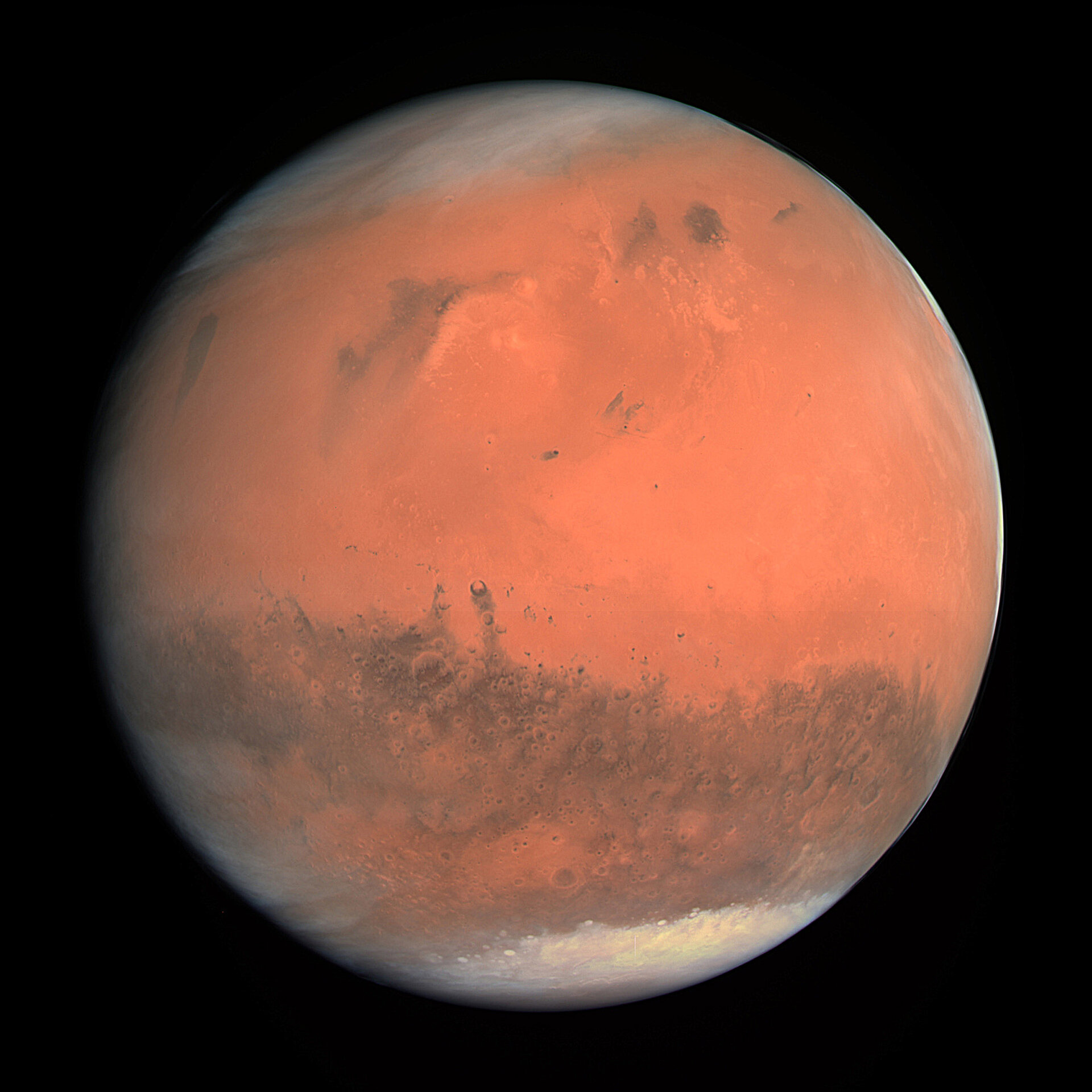
Mars has captured human imagination for centuries, from ancient sky watchers to modern space missions. Mars Day is celebrated on 3rd March, making it the perfect time to spotlight the Red Planet in your classroom.
Why not use Mars Day as an opportunity to explore the Red Planet with your learners? Here are some engaging Things To Do activities to help your students investigate Mars and our Solar System:
- Create a Pocket Solar System - Build a scale model to understand where Mars sits in our Solar System.
- What’s Your Age on Mars? - Watch the video and discover how a Martian year compares to an Earth year.
- Know Your Weight on Mars - Use our calculator to explore how gravity on Mars changes your weight.
- Order the Orbit - Test your knowledge by rearranging the inner Solar System into the correct order.
- If you’d like to take it one step further, you can even request your own observation of Mars using the Liverpool Telescope through Go Observing.
- Investigate the Size of Mars - Compare Mars with other planets and explore how planetary sizes are measured.
Mars Day is a fantastic way to spark curiosity about planetary science, exploration, and the future of human missions to space. Happy exploring!
International Women's Day
On 8th March, we celebrate International Women’s Day, recognising the achievements of women in all fields, including space science and astronomy! Women have played a crucial role in expanding our understanding of the Universe, overcoming barriers and inspiring future generations to reach for the stars.
Meet some of the incredible women from our Career Heroes:
- Mary Jackson – NASA’s first Black female engineer, who worked on aerodynamics and helped pave the way for more diversity in STEM fields. Her work contributed to key space missions, and she spent her later career advocating for more women in engineering.
- Jocelyn Bell-Burnell – The astrophysicist who discovered pulsars, one of the most important astronomical discoveries of the 20th century. Despite her groundbreaking work, she was initially overlooked for the Nobel Prize, but her contribution to astronomy remains invaluable.
- Samantha Cristoforetti – An ESA astronaut, engineer, and former Italian Air Force pilot. She holds the record for the longest uninterrupted spaceflight by a European astronaut and has conducted vital research aboard the International Space Station.
You can discover more inspiring figures on our Career Heroes page.
Are your students or children curious about careers in space? Let them explore these fun Things To Do activities:
- Space Jobs Game – Discover the many different career paths in the space industry by matching skills and interests to real job roles.
- Space for Everyone Quiz – Challenge stereotypes about who works in space and uncover the diverse range of people making discoveries beyond Earth.
Let us continue to celebrate the women who have shaped space science and inspire the next generation to follow in their footsteps!
.png)
International Day of Mathematics!
The International Day of Mathematics (also known as Pi Day!) on 14th March, is a wonderful opportunity to show students how maths helps us understand the Universe. From measuring mountains on the Moon to calculating the speed of planets, mathematics is at the heart of astronomy.
Why not use this day to explore how numbers unlock the secrets of space? Here are some of our Things To Do activities that combine maths and space in engaging, classroom-friendly ways:
- Maths with the Moon - Test mathematical skills with questions based on the Moon and the Apollo missions.
- Measure Mountains on the Moon - Use high-resolution lunar images and a bit of geometry to calculate mountain heights.
- Calculate the Speed of the Planets - Do all planets travel at the same speed? Use real data to work it out.
- Distances in Space - Use the speed–distance–time equation to calculate the length of a light-year and the distance to Alpha Centauri.
- Investigate the Size of a Galaxy - Use AstroLab tools and mathematical reasoning to measure the size of a galaxy.
- Measure Distance with Parallax - Apply geometry to calculate the distance to Barnard’s Star using the parallax effect.
- Measure the Sun’s Rotation - Use real data and careful calculations to estimate how long the Sun takes to rotate.
You can also inspire your students by exploring our Career Heroes in Mathematics. Or discover the biographies of influential mathematicians who shaped our understanding of the Universe, including: Brahmagupta, Aryabhata, Al-Khwarizmi, Isaac Newton, Johannes Kepler, and Hypatia. These stories are a great way to show learners how mathematics has shaped scientific discovery across cultures and throughout history.
Whether your learners enjoy problem-solving, data analysis, or applying equations to real-world questions, these activities show that maths is not just numbers on a page, it is a powerful tool for exploring the cosmos.
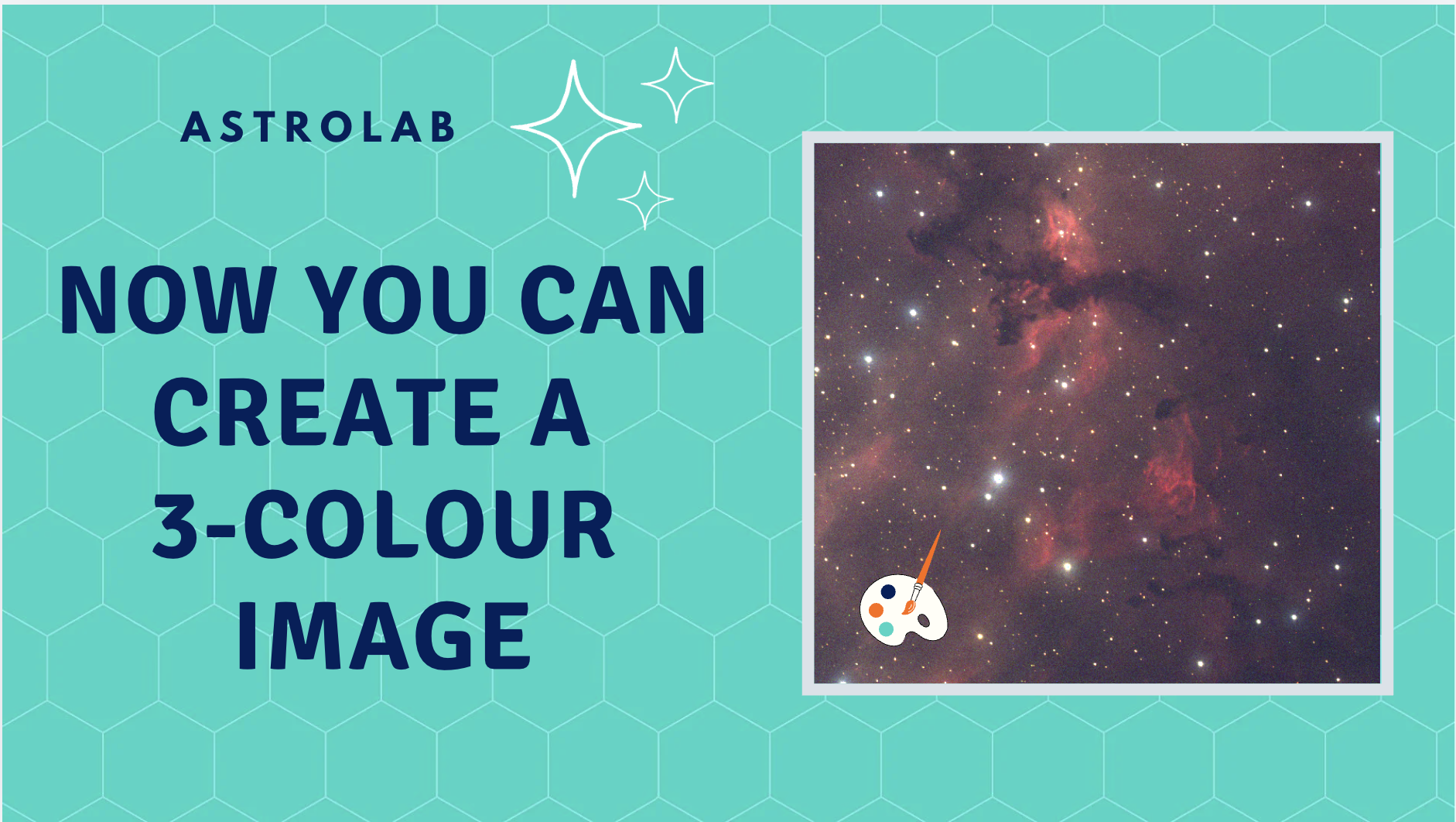
AstroLab Update: A Video Tutorial on How to Create 3-Colour Images!
We hope you enjoyed the new 3-colour imaging feature in AstroLab that launched last month!
It’s been lovely seeing educators and students getting creative with telescope images and we’re still very eager to see more of your colourful creations.
AstroLab helps you explore telescope images in different ways, and 3-colour imaging lets you go one step further by building a full-colour image, just like real astronomers do.
To help you get started, we’ve now added a video tutorial that walks you through the process step by step.
Watch the video and follow the guide here.
Happy, colourful exploring! And if you’d like to share what you make, please send your images to SchoolsObs@ljmu.ac.uk — we’d love to see them!
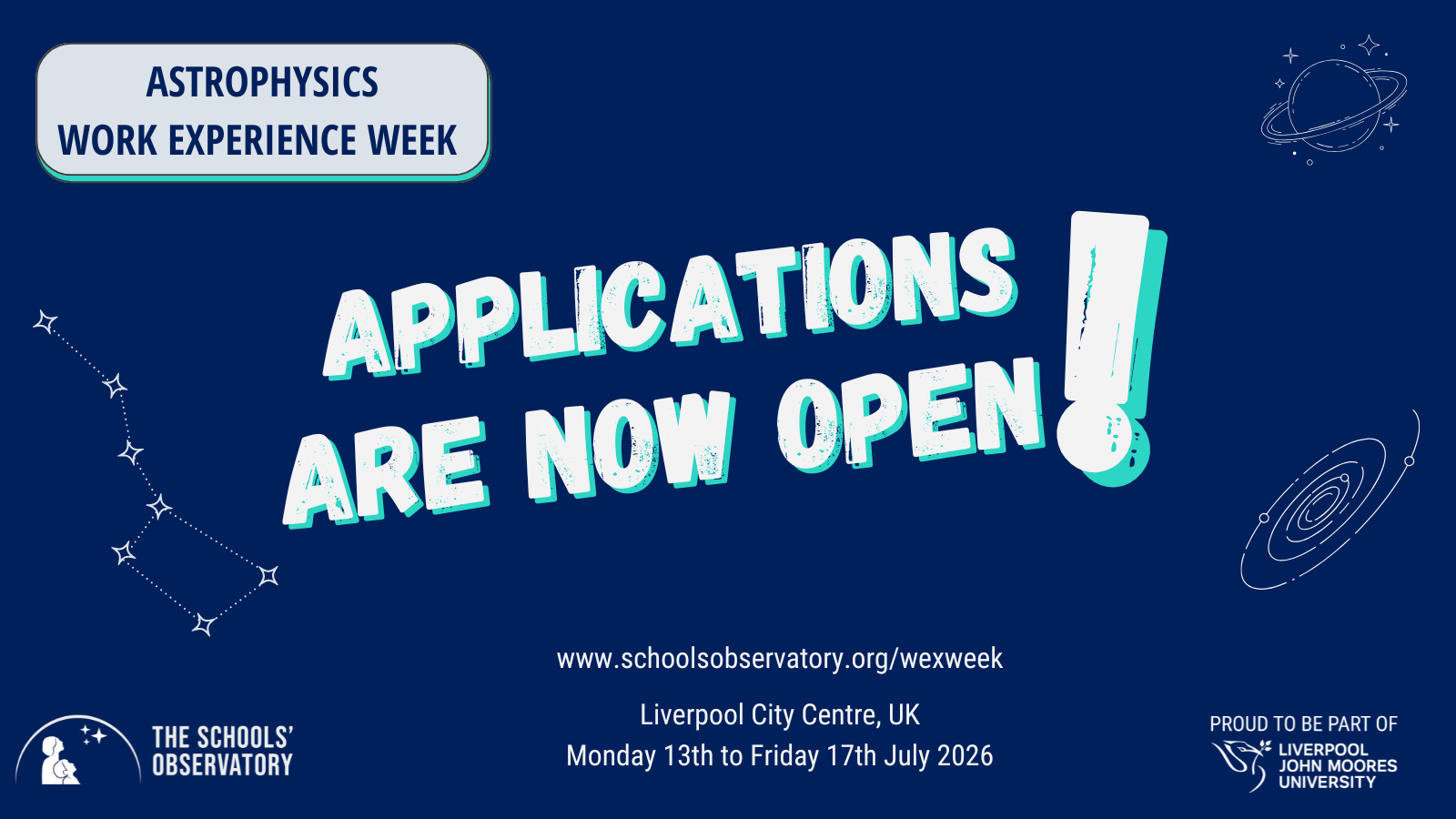
Work Experience Applications Are Now Open!
Applications for our annual non-residential Work Experience Week opened on 2nd February for students in Year 12 (or equivalent) in the UK and Ireland. Please share this opportunity with your students and your wider network.
This programme gives students a real insight into how professional research is carried out at a university. Throughout the week, students will take part in talks and hands-on workshops, then work in pairs to research an area of astrophysics and create a poster to present their work.
We especially encourage applications from students in the Liverpool City Region.
What students will explore:
- Introduction to Astrophysics Using Astronomical Data
- Introduction to Robotic Telescopes
- Design a Telescope
- Science Communication Skills
- University Life
- Careers in Physics
Students will also have the chance to chat with current university students and ask questions about studying at university.
For full details, eligibility criteria, and the application form, please visit our Work Experience page.
Help Us Grow: Join Our Online Focus Groups!
We’re always looking for ways to make The Schools’ Observatory better for you and your students and we’d love your help.
The Schools’ Observatory is free to use, thanks to generous funding from Liverpool John Moores University (LJMU). Our telescope time is also kindly supported by LJMU (via the Liverpool Telescope) and the Dill Faulkes Educational Trust (via the Las Cumbres Observatory Network).
Our mission is simple: to provide free, high-quality resources that inspire young people to think about STEM careers and support educators in teaching STEM subjects. To do this well, we need to understand the impact we’re having.
That’s why we’re inviting educators and users to take part in online focus groups, led by the LJMU School of Education, who are helping us evaluate and improve the service.
If you’d like to share your thoughts, experiences, and ideas, we’d really appreciate your time. Register your interest by filling in this form.
Your feedback helps shape what we do next and thank you for being part of our journey!
Look to the Sky!
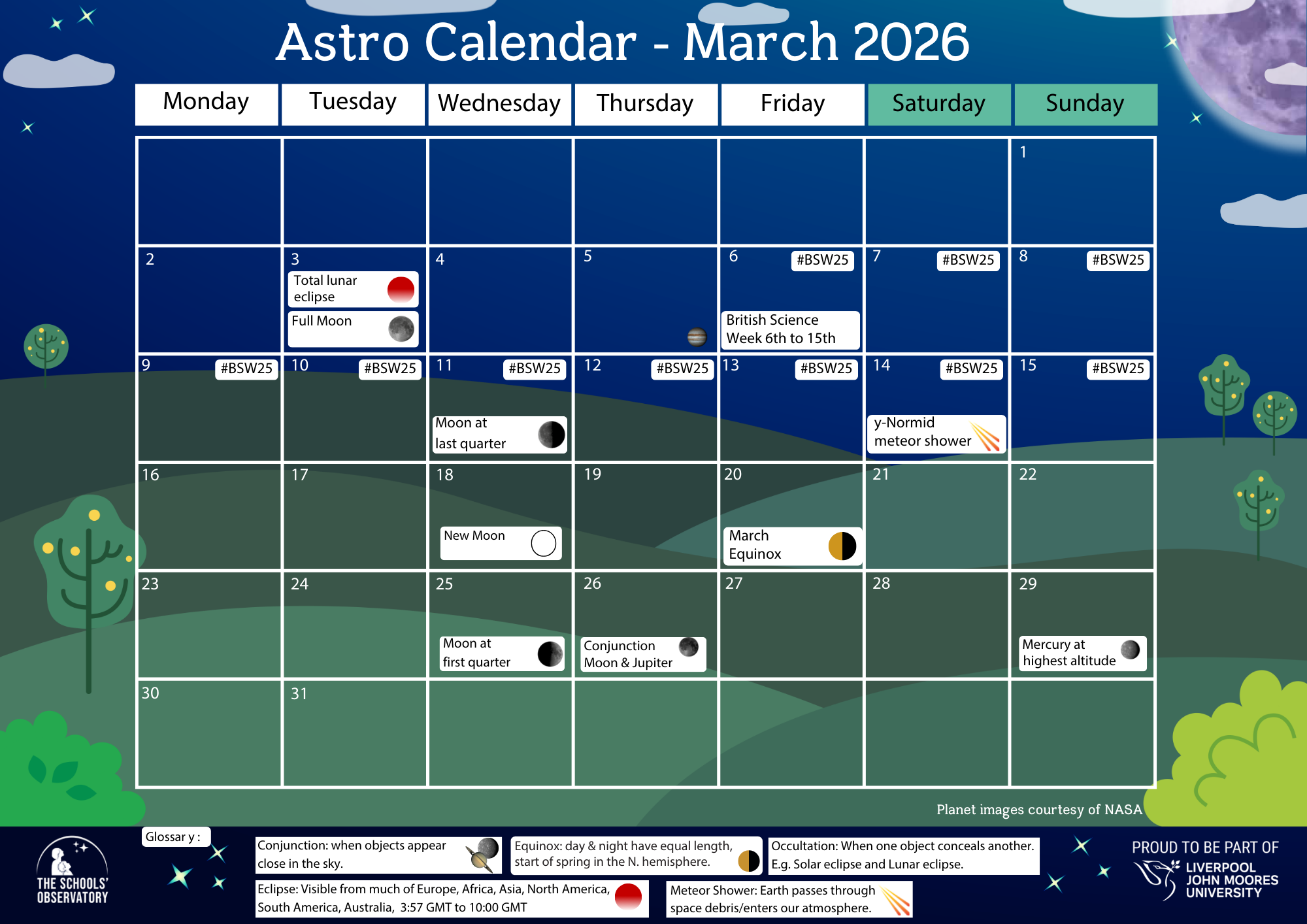
Plan your stargazing adventures with our March astronomy calendar! Download it to display at home or in the classroom. Get ready for an exciting month of celestial events, including total lunar eclipse, meteor shower, and conjunctions between the Moon and some of the Solar System’s most impressive planets. Don’t miss out on what the night sky has to offer!
Download and display March's astronomy calendar!